A weapon of mass corruption

Why are the crypto cartels trying to eat our democracy whole?
This scammy digital hustle was once derided as a tool for criminals, drug traffickers, terrorists, and pariah states like North Korea. Now its true purpose has been revealed: crypto is a weapon of mass corruption. Very few Americans use crypto, but crypto billionaires are pouring obscene amounts of money into our elections. And the Trump family is raking in billions in ill-gotten crypto wealth.
We’ve never seen anything like it, and it’s a gun to the head of democracy.
On this week’s episode of The Nerd Reich, I talk to tech researcher and writer Molly White, creator of the Citation Needed newsletter. Her essential project, Tech Influence Watch, exposes how tech oligarchs are flooding hundreds of millions of dollars through deceptively named super PACs to decapitate dissenters, capture federal regulators, and line Donald Trump’s pockets.
This is Silicon Valley’s hostile takeover of the USA. It’s happening in broad daylight. Click below to take a look at the receipts. (Audio-only links and full transcript below.)
- Click here to listen to The Nerd Reich podcast on Apple podcasts
- Click here to listen to The Nerd Reich podcast on Spotify
THE NERD REICH PODCAST: MOLLY WHITE (TECH INFLUENCE WATCH)
Transcripts are auto-generated and may contain errors.
GIL DURAN
The crypto cartels are trying to eat the United States alive, pouring unprecedented amounts of money into our politics. This scammy, weird cartel, which appeals to very few people, is now the biggest moneyed force in our political system. There's no better way to understand what's happening to our country today than to look at the degree to which the crypto cartels are attempting to seize power for themselves and hold a gun to the head of American democracy. And the AI companies, the venture capitalists and Elon Musk are doing the same thing. Putting hundreds of millions of dollars into the midterms, all to buy our political system and break it.
Today on The Nerd Reich podcast, I'm joined by tech researcher Molly White to discuss her crucial transparency project, Tech Influence Watch. Molly meticulously tracks Silicon Valley's efforts to buy the US government. Her work exposes a massive political heist underway. She documents the money flowing through benign-sounding super PACs to destroy uncooperative politicians. She also uncovers the billions pouring directly into the Trump family's pockets. So buckle up, because crypto is a weapon of mass corruption, and Silicon Valley's hostile takeover of the United States of America is well underway.
GIL DURAN
Hey Molly, welcome back to The Nerd Reich podcast.
MOLLY WHITE
Thanks for having me.
GIL DURAN
I think it's been a year since you were last on, and I wanted to bring you back on because right now a lot of people are very interested in my work because my book just came out last week. But I, in turn, am very interested in your work and your site Tech Influence Watch. The page you put up to track crypto and tech spending in politics right now, I think is one of the most important things going on in journalism. I wanted to make sure that my readers and listeners are paying attention to what you do. We're gonna go through Tech Influence Watch today on the show, but right now let's go back a little bit earlier. How did you get involved and interested in tech and crypto? Give us a little bit about your backstory.
MOLLY WHITE
Well, I've been interested in tech since a very young age. I've always been that kid who would rather play on a computer than go outside. But I was in the software world for a long time. I did a CS degree and then I was a professional software engineer for about six years, doing a lot of web development. And I've always been a big fan of the web. I love the web. I care a lot about the open web and the access to information and that type of thing.
And in 2020 or so, when crypto was re-entering the mainstream, and especially the term Web3 was being thrown around a lot to mean that blockchains were gonna underpin everything you do, especially online, but increasingly in basically every aspect of your life, I started to pay a lot more attention to it, because a lot of the pitch was Web3 is gonna fix everything that's wrong with the web. And I've had complaints about the web for many years now. There are issues with it being unequal, lack of control over the platforms that you use every day, that type of a thing.
And so at first I was curious and sort of open-minded about it, but as I began to pay more attention, I got to see the fact that every day people were being totally taken for a ride in this crypto world, with promises that crypto is going to reinvent the infrastructure of the web and make people rich overnight and anything you could dream of. And so I started to pay more and more attention to it out of that concern and out of the feeling that there was not enough coverage of it. Mainstream media was covering it very poorly. There were a lot of puff pieces about people becoming disgustingly wealthy overnight, and portraying crypto as the avenue by which people could do that. And it didn't seem like anyone was talking about the downside.
So I started to write about it. Kind of accidentally turned into someone who is now full-time writing about cryptocurrency, tech policy, and really the way that tech impacts people and the way that the tech industry is increasingly trying to control the government and the policy end of things in ways that really don't allow everyday people to have much of a say.
GIL DURAN
So you're someone with deep interest, deep knowledge, and who's not afraid to be critical, which is I think really rare, I've found. I mean, I'm pretty new to focusing on tech myself, and I'm kind of shocked that there haven't been more people like you. There's a new generation of tech writers and critics who aren't afraid to challenge the billionaire power, but I think we've seen this entrenched incumbency of people who are very comfortable with insider access. And that has meant that a lot of stories don't get told. And the media, which largely doesn't understand a lot of these things, ends up serving as a marketing tool for crypto scams where the vast majority of people are gonna lose their money while a handful of people get rich. So you can't make the story about the handful of people who somehow made out like bandits, because then you're telling people that it's a possibility that this lottery can be won.
I'm someone who's really down on crypto and speak about it in very harsh terms. I call it crypto cartels. I personally don't think there's any use for it, but you may have a different take on that. What is crypto? What is crypto for? What might crypto be good at if done correctly, if anything?
MOLLY WHITE
Well, I mean, I think when it comes to any technology, it's a question of what are the benefits and what are the costs, and do those benefits outweigh the costs? And every technology has benefits and every technology has costs. And that's true even for some of the most extremely beneficial technologies and the most extremely costly technologies.
When it comes to crypto, crypto is essentially a way of creating digital assets, things that can be traded online without any real-world asset backing it up. So there's no physical dollar, there's no gold bar, there's not even a business necessarily backing these tokens, or sort of the units of cryptocurrency. People love to speculate on the price of these assets, Bitcoin being the most well known, but there are thousands and thousands of cryptocurrencies, with the idea that if you buy low and sell high, you can potentially make a lot of money.
But there's also this narrative around crypto that this is going to be the new way that the financial system operates. And we're gonna get rid of legacy banking infrastructure. There's gonna be no more banking rails. It's all just gonna happen on blockchains, which is the fundamental technology that allows cryptocurrency to exist. And this has led to this almost shadow financial system of cryptocurrency companies that essentially have reinvented every aspect of the mainstream financial system, whether it's banks or brokerages or high-frequency trading firms. Whatever you can imagine, there's a crypto equivalent. And increasingly they're really trying to sell this idea that this is the future of finance, this is the fix to everything that's wrong with the banking system. You can sort of catch a pattern in the way I'm speaking about crypto, which is that any problem you can imagine, you can find someone in the crypto world who claims that blockchains will solve it. Banking is by far one of the main ones.
As for whether it is overall beneficial, I mean, there are unique characteristics of crypto and blockchains. Unlike some traditional finance, there are sort of aspects to blockchains where no single bank or financial firm or country controls, for example, the Bitcoin blockchain. It's sort of communally maintained by anyone who runs a Bitcoin mining operation, which used to be nerds in their basements with computers who were sort of communally maintaining the blockchain.
These days, because of the scale of Bitcoin mining, it's largely data centers, essentially, massive computing operations that burn huge amounts of electricity that a nerd in his basement can no longer compete with. Proponents of crypto will say that this is a benefit because the bank can't unilaterally control whether or not you send a transaction. Now, of course, critics of crypto will say that that's a bad thing, because being able to limit who can send financial transactions can be very beneficial for governments or financial watchdogs or law enforcement or whoever. So it's really up to, I think, a matter of interpretation.
But I think the one thing that's really important to remember is that for all the talk of reinventing the financial system, replacing legacy banks, and so forth, the primary use case of crypto is still speculation. And so the vast majority of activity that's happening in this crypto world is not banking the unbanked. It's not allowing people to make cross-border payments more efficiently or cheaply. It's not all of these sort of noble, publicly beneficial use cases. It's mostly gambling on the price of Bitcoin.
GIL DURAN
Seems the case. And for a long time people have said that Bitcoin has no real use case besides crime, gambling, human trafficking. Rogue states can use it to evade sanctions. But I think we found a new use case here in 2026. And that's why I want to now focus on your page here on Tech Influence Watch. I think that we've seen crypto, which a lot of people lose billions and billions of dollars speculating on, but a handful of people gain billions and billions of dollars winning, being at the top of the funnel, understanding when to cash out, how to ride these waves. And I think the new use case we're seeing from the billionaire crypto cartel class is as a weapon of mass corruption in our political system.
There's a section on Tech Influence Watch called Quid Pro Quo. It says that besides their congressional election spending, companies have poured billions into Trump and his family. Enforcement cases were dropped, investigations were closed, and industries were invited to write their own regulations. And the number you have there is $5.4 billion-plus to Trump and family, tracked by entities including countries like the Emirates, $2.3 billion; Saudi Arabia, $2 billion; Justin Sun and Tron, $232.7 million.
We'll get to the spending directly in elections in a minute, but this seems perhaps like the biggest story in American political history, I think. Donald Trump, who previously called crypto a scam, a scam against the dollar, who casually mocked crypto as a fake, dumb thing, became, according to The New York Times, a crypto billionaire on the day he returned to office, and is now the crypto bro in chief. Tell us what's going on in this Quid Pro Quo section. What are the crypto cartels up to here?
MOLLY WHITE
Well, I think you're right that we've seen unprecedented corruption from the office of the presidency, where President Trump and his family are making billions of dollars from cryptocurrency. And certainly the family has always had quite a lot of business ventures. Recently has become very heavily involved in cryptocurrency. They've launched World Liberty Financial, which is a cryptocurrency business that offers a stablecoin, which is a cryptocurrency that's meant to be pegged one-to-one with a dollar. They have launched this Trump meme coin, which was announced shortly before Trump's election. They've announced multiple NFT projects, which are sort of image-related crypto tokens, and those were related to Trump, or Melania had her own.
So there's just sort of this long, long list of crypto ventures that Trump has marketed to the public, certainly, but that also seem to be functioning as a way for various entities, often outside of the US, people and entities who may not be legally permitted to contribute, say, to his campaign, to funnel money to Trump and his family.
And we've seen, for example, the United Arab Emirates made a $500 million investment into that World Liberty Financial company to take a 49% stake in the business. And this was not publicly disclosed, it was reported upon long after the deal happened. This seemed to coincide with the agreement that the US would allow the UAE access to advanced AI chips, which was something that they'd been wanting for years and that the US had been restricting because of concerns over the level of sophistication.
And so this is just one example of the many deals in which we see Trump profiting and his family profiting from their cryptocurrency ventures, and then benefits flowing in the other direction to the source of the money. So, for example, you mentioned Justin Sun. He spent over a hundred million dollars on Trump and World Liberty Financial tokens. Justin Sun is a Chinese national. He is not permitted to contribute to Trump's campaign. These purchases were happening all throughout the early Trump presidency.
And then we saw this ongoing SEC case, a securities enforcement case against him personally, as well as his business Tron. It was settled for $10 million, which was a slap on the wrist to a billionaire like Justin Sun. And this was an SEC case that not only alleged the operation of an unregistered securities exchange, which is sort of the standard SEC case we see against crypto companies, but it actually alleged fraud, that Justin Sun had been engaged in much more serious malfeasance with his crypto firms, and yet it was dropped for a $10 million fine.
Justin Sun had actually been very obviously avoiding setting foot in the United States for a number of years. He had purchased a space flight to go to sort of like low orbit, and he spent millions of dollars on it and he skipped the space flight, seemingly because he didn't want to come to the US. But then shortly after all of this money went to Trump, he was posing in front of the Hollywood sign. He was going to a Trump meme coin event in Virginia. He was touring the White House, and he took that space flight ultimately. And so it seems like he suddenly was much less concerned about the potential of criminal enforcement actions against him.
And the list goes on and on. I mean, practically every cryptocurrency firm you can think of, the big names, Coinbase, Kraken, Gemini, all of them have donated to Trump's campaign or supported various endeavors like the ballroom project or the military parade that he held in 2025, or all kinds of different things. And then the ongoing cases from the Securities and Exchange Commission were dropped, or they were dismissed with prejudice in a number of cases, meaning that they can't even be refiled. And we're talking 20-plus enforcement cases against crypto firms that were dropped under the Trump administration.
GIL DURAN
You know they're in trouble and scared when they skip a space flight, but fortunately apparently crypto even has the power to solve that problem for a billionaire on the run.
It is amazing. To me it seems almost like an alien invasion, or like a Godzilla rising from the ocean. I worked in politics for a long time. I'm definitely familiar with how campaign finance and funding works, and I don't think we've ever seen anything like this emergence of crypto, which back in 2022 and before had a very tiny footprint in political spending and has suddenly, with no restraint or shame, it's like a tsunami that's just coming to swallow the entire system of our politics. When you look at a chart, we're gonna have to have R.R. do some kind of chart that really suggests the scope of this, because I think people don't understand visually the degree to which this is bizarre. I've been comparing its growth rate to cancer. Off-the-charts growth that won't stop.
And I guess the question is what they're trying to buy. And obviously power, influence. There's specific things they want. They want to legitimize crypto. They got the GENIUS Act through. Now they want the CLARITY Act passed. And we'll get to those things in a minute. Let's take a look at some of the numbers here at the top of Tech Influence Watch. Industry contributions, $444.8 million from tracked cryptocurrency and artificial intelligence industry companies and individuals. What does that number mean?
MOLLY WHITE
So that's the amount of money that the cryptocurrency and AI companies that I track on this site have contributed either to super PACs or to candidates' campaign funds, basically any sort of political contributions that we've seen this cycle. So this is just in the past, you know, 2026 midterm election cycle. Not all of that money has been spent. So for example, there's a couple hundred million dollars sitting with these crypto and AI focused super PACs, which are specifically focused on promoting the interests of either the crypto or AI industries.
But a significant amount of it has been spent. So for the cryptocurrency industry specifically, they've spent almost $80 million already this cycle. For comparison, in 2024, the cryptocurrency industry spent around $130 million. And so we're already well on track towards that number. And we've not even finished the primary season at this point. When you add in AI, we're looking at much bigger numbers. I mean, the two industries combined have already surpassed that $130 million that we saw from crypto in 2024. And neither of these industries were major players prior to that.
So in earlier years, we'd seen a little bit of dabbling from especially FTX, which is a crypto exchange that actually collapsed in 2022. They had begun to become involved in politics and really sort of laid some of the groundwork for some of these super PACs. But suddenly in 2024, basically out of nowhere, there was $130 million in political spending out of crypto, which was one of the largest single industries to contribute to politics that cycle. And so the amounts of money that they're really pouring into elections right now are staggering.
GIL DURAN
Sam Bankman-Fried, the head of FTX, who kind of pioneered crypto's role in politics, had fantasized about paying Donald Trump not to run in 2024. I think the price they had in mind, from what I read, was five billion dollars. And of course, now he's in federal prison because it turns out he was running a massive criminal scam and it all fell apart.
And it also turned out that FTX was also funneling money to Republicans. He was largely categorized as a Democratic player, but he was playing both sides. And we see that happening now with crypto. To me, it seems clear that they'd rather have the Republicans, because Donald Trump is more destructive, more corrupt, will give them what they want without any delays or pushback, maybe just asking for more crypto for his family or whatever. He can be bought. But at the same time, we do see the crypto cartels pouring money into Democrats as well as Republicans, and sometimes they're spending on both sides, right?
Walk us through a couple of the races where crypto spending has been definitive and unusual and played a role. Give us a sense of what they're actually doing with that money in these individual campaigns.
MOLLY WHITE
Well, it's interesting to watch, and you're absolutely right to highlight that some of the spending is going towards Democrats, because there is often this perception that crypto is a specifically Republican issue, that only Republicans are getting on board with this crypto agenda, and that that's really the only focus of this crypto spending. And that's not the case. The crypto industry, I think, is pragmatic and realizes that there are districts in which a Democrat is almost certain to win. And so they view it as a worthwhile effort to try to elect a more pro-crypto Democrat in a race like that, or to try to oust someone who has been a significant opponent of crypto.
And we've seen that happen in a couple of different cases. So for example, in 2024 we saw the biggest target of crypto spending was in Ohio's Senate race, where Sherrod Brown was defeated by Bernie Moreno. Sherrod Brown is a Democrat who had been very outspoken against cryptocurrency, attempts to pare back the regulations about cryptocurrency, and certainly outspoken about the harms that it can do. Bernie Moreno, on the other hand, has been one of the crypto industry's most powerful allies. Sherrod Brown was sitting on Senate Banking. Now Bernie Moreno is on Senate Banking and has helped shepherd through bills like the CLARITY Act, which made it through Senate Banking but has not passed the Senate and is currently stalled out. And that race saw $40 million in spending in 2024.
There have been similar attempts this cycle to try to remove Democrats who have been outspokenly against crypto. So I think one of the best examples is in Texas's District 18, where Al Green is running for election. He's actually facing another incumbent because of redistricting. So it was kind of a tough race between those two to begin with. But we saw $5 million go into that race to support Christian Menefee and to oppose Al Green, with the crypto industry hoping that they would no longer have this outspoken opponent of both cryptocurrency but also Trump's corruption in Congress.
And so those are some good examples of where Democrats are really coming out. We're also seeing massive spending in races like Alabama's Senate race to support Barry Moore, in Kentucky to support Andy Barr. And the list really goes on.
One of the interesting things about the crypto industry's strategy is they often sort of back the winners. So we see them backing candidates who are really likely to win their races already. This serves two goals. For one, it allows the crypto PACs to really pump up their numbers a little bit so that they can say, you know, 80%, 90% of our candidates won their elections. And they say things like, this proves that American voters want the same things that we do. They want crypto legislation, they want the end to the war on crypto and all these types of things. So it's very useful to them in this marketing sense.
But it also helps them really buy allies in Congress, where the crypto industry backed you to the tune of a couple million dollars during your race. Even if it wasn't a deciding amount of money, or if you were likely to win anyway, they can sort of call in that contribution later when they're lobbying for some bill or some change, to say, look, we backed you. Now it's time for you to hold up your end of the deal. And I think we've seen that repeatedly since 2024.
GIL DURAN
To me, one of the most eye-opening crypto spending campaigns was the $10 million spent against Katie Porter in her race for California Senate. I felt she was gonna lose that race anyway because Adam Schiff had the edge, but nonetheless they went in and just bombed her with $10 million in spending to bring her down. And it worked.
MOLLY WHITE
Yep.
GIL DURAN
Right. And what I think they were doing was they were just sending a message to everybody. That's why I call it a gun to the head of politics, because having worked in politics, that's how it works. They're showing you we will just go and spend all this money, even if you're probably gonna lose anyway. They're doing the Machiavellian thing of taking a head.
And what's interesting to me is that Fairshake, the main crypto PAC, is headed by Democratic operatives. Chris Lehane, who I worked with on some stuff 10 years ago, was doing progressive campaigns in California 10 years ago. But he got on this track of the crypto money and now he's also at OpenAI. Josh Vlasto was the communications director and top aide to Schumer. So these are not Republican operatives doing this, these are Democratic operatives.
And I know the strategy. The strategy is to scare the hell out of anybody who will dare to oppose crypto, and to preemptively butter up any politician in advance so that they don't even get the idea to possibly oppose crypto. And the scariest thing about it is that when Katie Porter ran for governor of California this year, she was backed by a major crypto billionaire, Chris Larsen, because she had changed her tune on crypto. She was pretty much a strident opponent and a critic of crypto before. But not only did Larsen back Katie Porter, he also backed Steve Hilton, this right-wing former Fox Republican racist anti-immigrant news host. He bet on both sides.
And this to me is like a perfect example. I mean, if you don't know who Chris Larsen is, he's a founder of Ripple, which is supporting the Trump regime and also supporting Democrats. And Larsen makes it really clear. They're gonna buy both sides. And what's funny, though, is he bet on two losers. Steve Hilton's not gonna win. Katie Porter came in like in third or fourth. So it didn't work. But they show us who they are by trying to bet on both sides. And what was scary to me was the degree to which Katie Porter, formerly taken down by $10 million in crypto spending, was now being funded by a crypto billionaire and no longer on her former talking points against that industry. And of course it was a strategy spearheaded by Democratic operatives. And to some degree, it worked.
The other part that's weird about this is the talking points tend to be that Americans want the war on crypto to end. Very few Americans use crypto. And it seems like the more and more who do, they're losing money. So crypto is one of these products where people are going to get burned and be against it. I think last year Pew put it at under 20% of people own or use crypto. So you have a weird, scammy technology that's used by a very small number of people becoming the outsized influence in our politics. And that's just utterly bizarre.
MOLLY WHITE
I do think that that narrative is a major portion of the crypto super PAC strategy, is really to sell this narrative that Americans love crypto, that voters love crypto. And this is a narrative that they sell to the public, certainly, but also to candidates, because they think it's incredibly important to convince political candidates, whether theyre incumbents or new entrants, that there is this group of Americans who are just sitting on the sidelines waiting to support whichever candidate comes out in favor of the crypto industry's agenda.
And they even commission their own polls to try to come up with this narrative that Americans love crypto, they're using it all the time, that they support it. They'll ask all these misleading questions about, essentially, do you support financial freedom, or do you support fewer restrictions on what you can do with your money, and things like that. And then they sort of twist answers to those questions to mean that respondents who answered positively were suggesting that they support crypto, even though that's not what the question was asking.
And I think it does work to some extent. I think we've seen candidates really buy into the idea that, okay, I guess if I take this crypto talking point, then maybe I'll win over these voters. And they say that it's a way to win over young voters or male voters or voters of color oftentimes, which are often demographics that candidates are specifically trying to target. And so it's this very cynical way of convincing candidates, both through the money end of things, but also through the, hey, this is gonna help your campaign.
And it was really interesting, you brought up Chris Lehane, the strategist. There was a great piece in The New Yorker after the 2024 election cycle where he had been working with Coinbase, and someone brought up the point that, like, hey, the data doesn't actually support that idea that there's this bloc of crypto voters out there waiting to support pro-crypto candidates. And Chris Lehane responded, okay, then we'll just invent one, essentially. He basically said, we'll have to just make it up.
It's very openly apparent that the crypto industry does not actually believe that there are all these people out there who support crypto. And you only have to look so far as their political ads to understand that, because if you look at a race where the crypto industry is supporting a candidate and you look at the ads that they're running, they don't mention crypto. They rarely mention finance or technology at all. And they just mention whatever they think in that particular race will resonate with voters. And so it's very common issues around creating jobs, even coming out against ICE, for example, in some of these districts, even though we watch the crypto PACs also backing some of ICE's biggest supporters. And so it's this very mercenary advertising strategy that really recognizes that if they were to run an ad that said, hey, this candidate is gonna fight for the crypto industry, or that this candidate is gonna prioritize crypto issues, that would turn off voters. It would not encourage people to vote for that candidate.
GIL DURAN
If you elect me, I'll make sure the crypto corporations can rip you off mercilessly.
MOLLY WHITE
Right.
GIL DURAN
That would not really sell to most people. And I think that's a vulnerability. And yeah, these are some old tricks, manufacturing consent. Lehane has a very limited bag of tricks, but he's really good at getting the media to portray him as a genius. I mean, forget about his pathetic defeats. It's the same bag of tricks every time. I've read, I don't know, five or ten profiles of the guy, and it's always the same, and it's really more a symptom of the media's stupidity than of his brilliance.
So two of the main goals of the crypto industry in the past few years have been to get these big pieces of legislation passed to further legitimize their doings. One was the GENIUS Act, and the other one that right now is ongoing is the CLARITY Act. Briefly tell us what the GENIUS Act was and tell us what the CLARITY Act is, what it would do. And there seem to be some very specific sticking points that are preventing it from getting a little further along in Congress.
MOLLY WHITE
So the GENIUS Act, as you mentioned, is a specific bill aimed at regulating the stablecoin sector, which as I mentioned before is a subgroup of cryptocurrencies that are essentially assets that are pegged one-to-one with a dollar. And so the idea is basically, if you give me a dollar, I'll give you one token that represents a dollar, and then you can use that within the crypto ecosystem to trade crypto or whatever it is that you might want to do.
And these have existed for a long time, stablecoins. They've always been fairly unregulated. The biggest stablecoin is called Tether. It's offshore, it has never really undergone an audit. They've most recently claimed to, finally, after years of promising it, and then still won't release it. And so, not entirely above board. In fact, Tether had faced legal challenges from the New York Attorney General that actually proved that at times Tether was not backed one-to-one as they claimed. And so there are all these issues around people don't really trust stablecoins, trying to make stablecoins more of a legitimate part of the financial system, not just this sort of fringe crypto idea.
And so that was really the goal of the GENIUS Act, was to build some infrastructure that would legitimize stablecoins and really benefit some of these major crypto companies like Coinbase, for example, which is heavily involved with stablecoins. And of course, Trump has his own stablecoin, USD1, all of which benefit from the legitimization of stablecoins. And so that passed last year and is coming into implementation now.
Then there's the CLARITY Act, which is a really broad-ranging cryptocurrency market structure bill aimed at defining from the top down who is going to regulate the crypto sector. Because there has been for years now this fight that, okay, the Securities and Exchange Commission has sort of taken on the role of the primary crypto regulator. The crypto industry hated that. They didn't want that to happen. They much prefer the idea that the commodities regulator in the US, the CFTC, would regulate crypto, in large part because it has much less authority, it's a much smaller agency, its enforcement capabilities are much smaller. Now, of course, they're both run by Trump loyalists, which is of course very beneficial to the crypto industry.
And so among the things that the CLARITY Act would do is it would make the CFTC more of the primary regulator for crypto. And it would make this much friendlier operating environment for crypto, with various portions of the bill addressing things like illicit finance, addressing the transparency that's required of some of these companies, the circumstances under which they can issue and sell tokens, and so on. It was essentially written by the cryptocurrency industry. We saw crypto executives essentially living on Capitol Hill for a number of months, giving input on this bill, lobbying for this bill.
But it did in fact run into some political issues where it has been stalled out in the Senate. They have been pushing and pushing and pushing to try to get this bill passed, but there have been sticking points where either the cryptocurrency industry doesn't agree, or we've actually seen significant opposition from the banking lobby against this bill, worrying that it could cause deposit flight essentially from community banks, by causing people to withdraw their money from banks and instead put them into stablecoins and similar vehicles.
And so there's been a number of issues that have stalled out the bill around, as I mentioned, stablecoin rewards. Also, Trump's corruption has been a major issue with this bill, where there have been demands from Democrats to add anti-corruption language that would limit Trump and his family potentially from being involved in the crypto sector, profiting from crypto. And then a handful of other things around illicit finance and so on and so forth, where, for example, law enforcement agencies have objected to various clauses as...
GIL DURAN
It's gonna be kind of funny if they can't get the bill passed because they can't agree to limit the Trump family's corruption.
MOLLY WHITE
Yeah.
GIL DURAN
And I wouldn't put it past Democrats to vote for a bill that didn't do that at this point, as long as there's enough crypto money flowing in everyone's direction.
MOLLY WHITE
Well, and we saw the crypto industry pushing very, very hard to try to get a vote through first before the August recess. Now they're really pushing to get one through in September, because what they want... they don't actually think that a vote will pass the bill at this stage. I think they've actually more or less given up on the prospects of the bill passing under this Congress. But what they want is to get the Democrats on record voting against this bill so they can then target them in the midterms. And they've essentially said as much explicitly, which is that we need to get a vote on record and then we will use that opposition as our target list as we use the rest of our multimillion-dollar war chest going into the general election.
GIL DURAN
It's truly amazing what they've done. We've never had, I think, someone try to swallow our political system whole in the way that crypto is doing. To me, it'd be like if the drug cartels suddenly rose up and decided they're gonna be the biggest player in politics, and anybody who doesn't vote for what they want will get hammered with millions and millions of dollars in spending. But this has somehow become normal. But it's not normal. It's deeply abnormal what's happening right now. And I think the clearest idea you get of what's happening to our political system comes from looking at how much is being spent by crypto and now AI, which is copying the crypto playbook.
MOLLY WHITE
Absolutely.
GIL DURAN
And that's why Tech Influence Watch is now my homepage on my computer, because I want to look at that every day, even if the numbers don't change much day to day, to remember what's happening and what's at stake. So Molly, tell us, in the next six to twelve months, what should people be watching? What should they keep an eye on to see where things are going with all of this?
MOLLY WHITE
I think one thing that's really important is look at your local race. Look at the race where you're gonna be voting and see, has any candidate in those races taken money from the cryptocurrency PACs, from the AI PACs, or directly from the executives? And really hold them to task on that. Ask them why they're accepting money from people who are trying to elevate their business interests over the interests of people who actually live in that district and whose interests are supposed to be represented by elected officials.
And consider opposing those candidates, because we can't allow corporations to buy our political system. We need to find candidates who are going to reject that kind of money and ultimately, I hope, prevent that kind of money from being involved in politics going forward. I think that's really the biggest thing, is reforming our elections so that there isn't this type of billionaire control over the political system.
Also just being aware of which interests are getting involved in your local elections, because a lot of these super PACs have names that are really, really benign, and very intentionally so. So you'll watch an ad and at the end it says, this ad was paid for by Fairshake. And it's like, yeah, Fairshake, that sounds nice. That doesn't imply anything about crypto. But sure enough, that is the biggest crypto PAC. And the same thing is true in the AI world, where they have PACs with names like Think Big and Leading the Future, which say nothing really, and intentionally so, because if you had an ad that at the end said this is backed by the crypto industry, people would probably be a little more skeptical.
And so I think just being informed about where this money is coming from is really important. And then encouraging your elected officials to vote against these bills, which are again written by the crypto industry, directly intended to benefit those people. The same billionaires who have made huge amounts of money off of everyday people through the crypto sector are trying to only bolster that bottom line with these bills that will basically get rid of what minimal consumer protections even exist.
GIL DURAN
The Fair Shake thing really pisses me off, because 10 years ago I was working on something called Fair Shake in California. And it was an effort funded by NextGen California, which was funded by the billionaire, progressive billionaire Tom Steyer, to push pro-family, pro-worker, pro-environment legislation in California. And that was our whole thing, was the Fair Shake plan. And we got the name Fair Shake from Chris Lehane, who literally took the same damn name ten years later once he sold his soul to the crypto billionaires and applied it to this horrific evil PAC that's trying to eat our country. I don't think a lot of people know that, but I know that on a very deeply personal level. It's sort of a nightmare to be in the middle of this and see that it's even the recycling of the name.
MOLLY WHITE
Right. There's not really much original thinking there.
GIL DURAN
Yeah. Machiavellian. Threaten people with a big money cannon and even use the same name. So crypto is corrupto. Keep that in mind, folks. Molly White, thank you so much for joining us again on The Nerd Reich podcast. And anytime you want to come back, you're always welcome here.
MOLLY WHITE
Thanks so much for having me.
R.R. ROBBINS
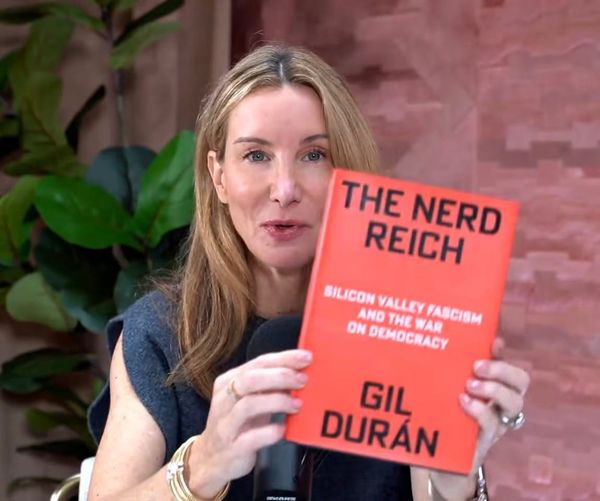
And that's the show. Thanks to our guest Molly White. Follow her work at Tech Influence Watch, at influence.citationneeded.news. Also, buy Gil Duran's book if you haven't yet: The Nerd Reich: Silicon Valley Fascism and the War on Democracy, now a New York Times instant bestseller and available at bookshop.org or wherever you buy your books.
Today's episode was written and hosted by Gil Duran. It was produced, edited, and announced by me, R.R. Robbins. Additional editing by Chee Hui Lim. Please subscribe to our newsletter at thenerdreich.com. And subscribe to our channel at The Nerd Reich News on YouTube. And leave a comment, we read those. Also, thank you to our audience for one million views on YouTube. All organic. We truly appreciate your support.
Today's final words on crypto are from today's guest, Molly White: "The scale of industry spending is fueling overt government corruption. The deregulatory agenda they're buying poses urgent threats to financial stability, consumer protection, and democracy itself."
On that note, see you next time on The Nerd Reich podcast.