
Malaysia Crushes Network School. Balaji Flees to Kazakhstan
Network State’s colonial ambitions did not go over well in the formerly colonized Muslim-majority country


Key Points:
- Malaysia shut down Network State cult “school.”
- Outraged citizens on social media called for expulsion of Network State, which founder Balaji Srinivasan (a close Peter Thiel associate) has described as "tech Zionism."
- Without acknowledging defeat, Srinivasan announced a new location for his cult project.
- See my post on Threads that went viral in Malaysia.
Malaysian officials have ordered Network School to shut down operations. The so-called school, run by Network State cult leader (and Peter Thiel protégé) Balaji Srinivasan, had claimed to be creating a new nation on Malaysian soil. The Network State is a cult ideology that seeks to replace existing nations with new nations run by tech corporations.
“The State Government and Local Authorities will not compromise on any breach of laws or matters that could affect national security, sovereignty, and interests,” wrote Onn Hafiz Ghazi, chief minister of the Malaysian state of Johor, in a media statement that said Network School’s business license had been revoked.
In 2024, Srinivasan announced the creation of Network School, a kind of co-working camp for tech entrepreneurs who seek to create their own countries. Srinivasan kept the details vague, but initial reports suggested he had “acquired” an island somewhere near Singapore, where he lives. In reality, it appears he had leased space in a failed Forest City housing development, a “ghost city” on a small island in Johor, Malaysia.
The Network School ran afoul of Malaysian authorities after reports that it had allowed Israelis to participate in violation of Malaysian law, which bars Israeli citizens from entering Malaysia. Investigators did not find any Israeli passports at Network School, but the controversy put Srinivasan’s cult compound under scrutiny.
Suddenly, thousands of Malaysians became aware of the goals of the Network State cult, which seeks to create new tech countries via a model Srinivasan has described as “tech Zionism.”
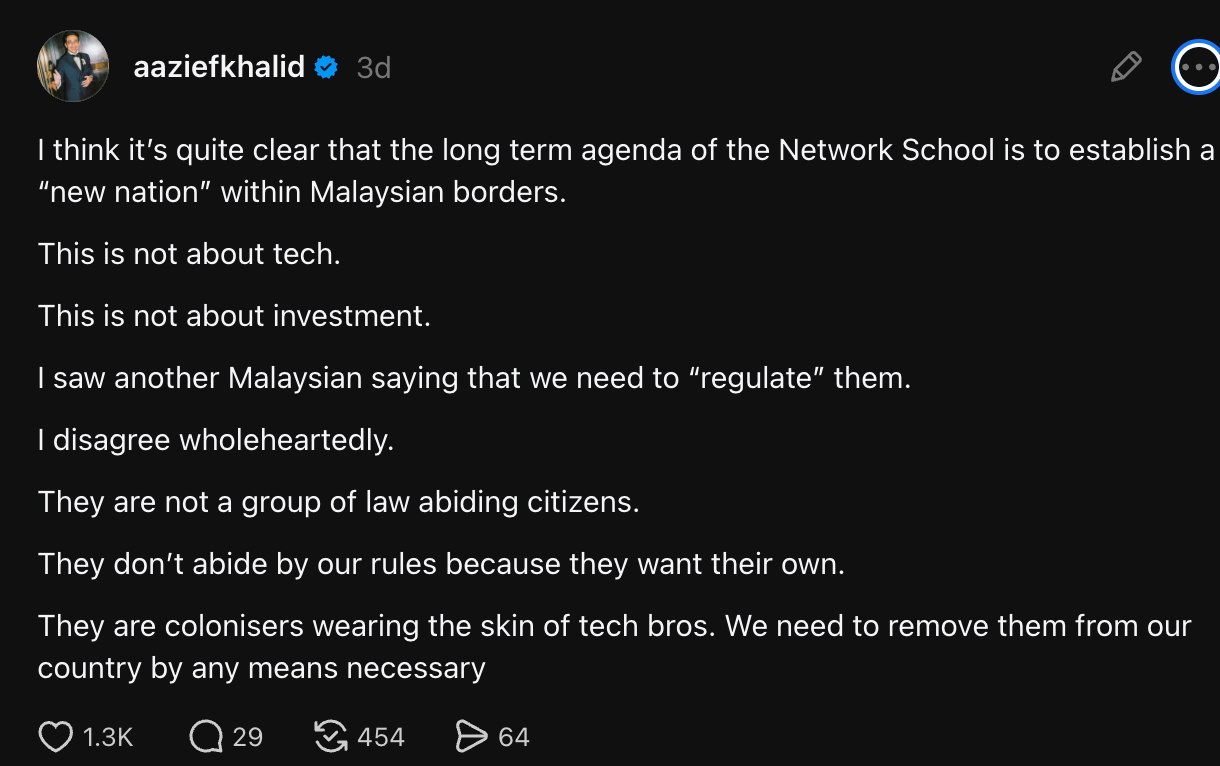
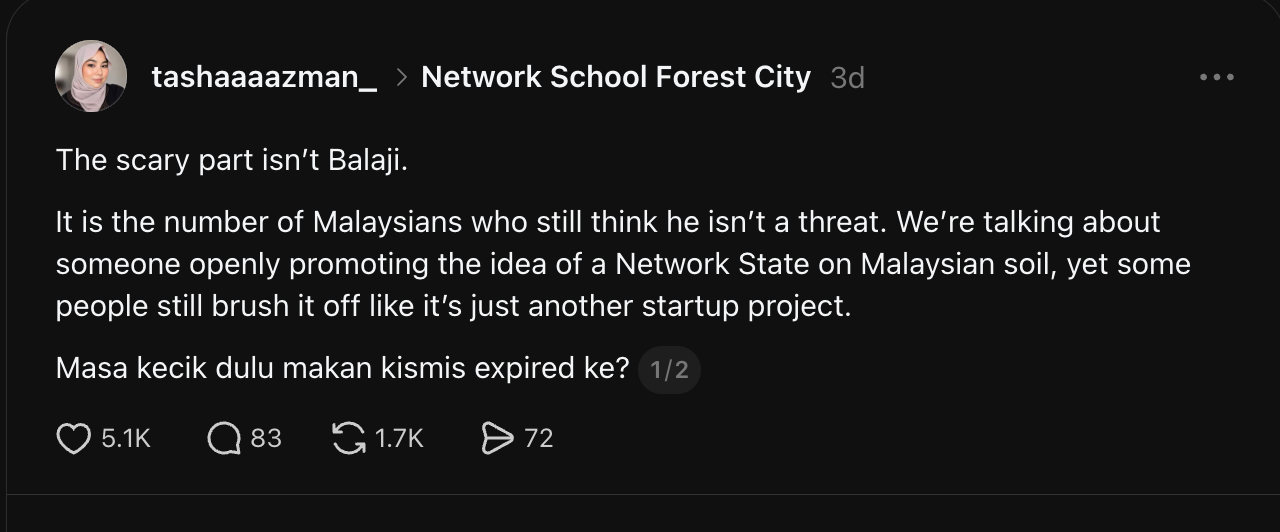
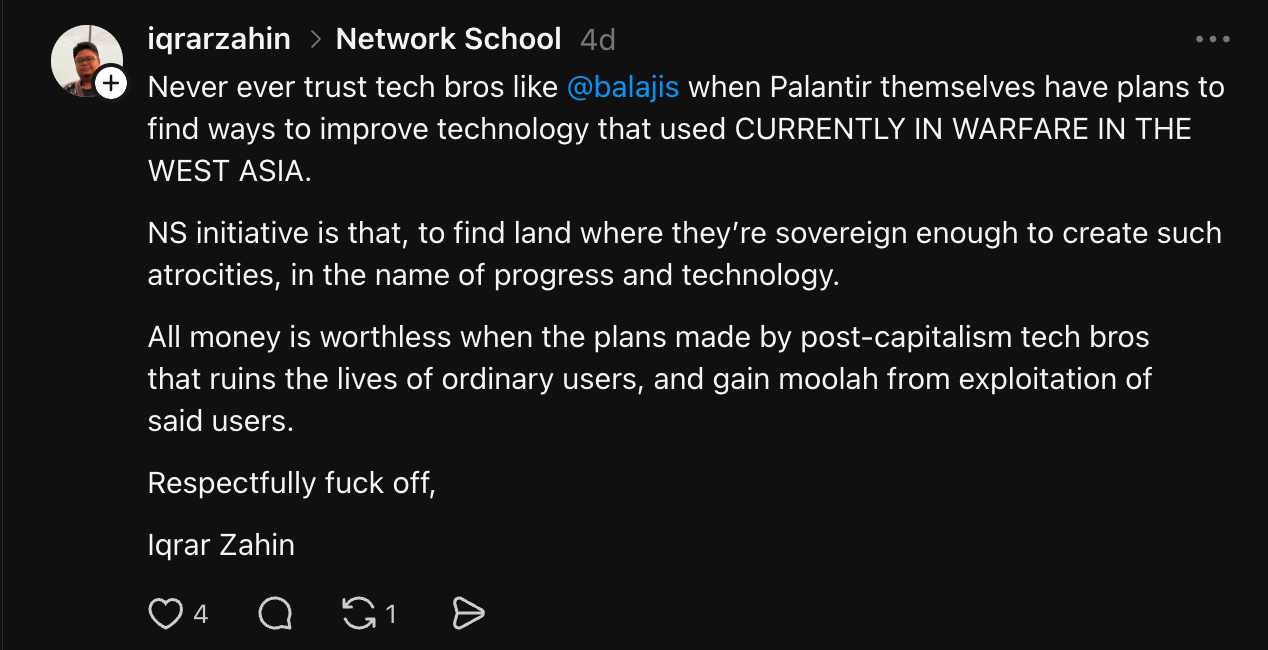
Malaysians reject Network School on Threads
“Concerns have also been raised over Srinivasan’s mission, outlined in his 2022 book The Network State, to set up new decentralised communities separate from existing nation states, which some social media users said posed risks to Malaysia’s sovereignty,” reported Reuters.
The Network State’s Zionism-inspired colonial ambitions did not go over well in the formerly colonized Muslim-majority country. Neither did Srinivasan’s equally wrong-headed response to the scandal.
Srinivasan had demanded a meeting with Malaysian Prime Minister Anwar Ibrahim, threatening a major withdrawal of tech investment if his demands weren’t met. This led some Malaysians to charge him with “arrogance” and demand his expulsion.
In addition, Malaysians raised fears that their country was being targeted by a high-tech colonial scheme similar to Prospera in Honduras, where Network State-aligned tech moguls funded a new settlement and are suing the Honduran government for nearly $11 billion. A similar city-building scheme has been proposed for Greenland, which President Donald Trump keeps threatening to take from Denmark.
The Network State’s main billionaire backers are also major supporters of Trump, including Coinbase CEO Brian Armstrong and venture capitalist Marc Andreessen. Srinivasan formerly worked at Coinbase and Andreessen Horowitz.
Over the weekend, it became clear that Network School did not have a future in Johor. Thousands of Malaysians excoriated Srinivasan on social media, ordering him to leave the country. Among other things, they expressed outrage over the claim that Network School was located on an “island near Singapore,” which they interpreted as a major snub to Malaysia.
Srinivasan, who seeks to remake the world order, failed at the most basic steps of diplomacy. His bombastic marketing came back to bite him, providing the outrage fuel that brought his Malaysia project crashing down in less than a week. His impertinent demand to meet with Malaysia’s prime minister blew up in his face and likely expedited Network School’s ejection.
“Super excited for this to go down as one of the worst/best own goals ever scored in the history of entirely avoidable PR disasters,” said one observer on social media.
In the end, Network State’s cancellation was decided by the Iskandar Puteri City Council, a move that put Srinivasan in his place.
“[N]o investor, company, or organisation can be placed above the sovereignty of the country’s law,” said Johor Chief Minister Onn Hafiz.
What’s amazing is how quickly Malaysians acted. While the US media largely ignores the Network State ideology (even as it swallows the US government whole), Malaysia wasted no time in pushing back on the Network State’s explicit goals. In thousands of social media posts, citizens expressed fear of a billionaire-backed cult that seeks to overthrow the global order. They wondered why such an organization was building its headquarters in their country. Now, it’s history.
It’s a model for how the rest of the world should respond when the Network State comes knocking.
Srinivasan responded with dramatic measures to cover up his astounding defeat. After denying that Network School would leave Malaysia and going silent on X over the weekend, he posted a video of a ceremony in Kazakhstan, where he apparently signed a rush agreement to open a new campus. Kazakhstan has proven to be more friendly to the Network State and is even planning a “crypto megacity” near the capital of Astana.
“I am pleased to announce that a memorandum of understanding has been signed between the Republic of Kazakhstan and Network School,” wrote Srinivasan. “Our new campus will become a haven for global techno-optimism, with expedited visas, streamlined redomiciliation, and active recruitment of talent.”
Welcome to Uz-Tech-Istan.