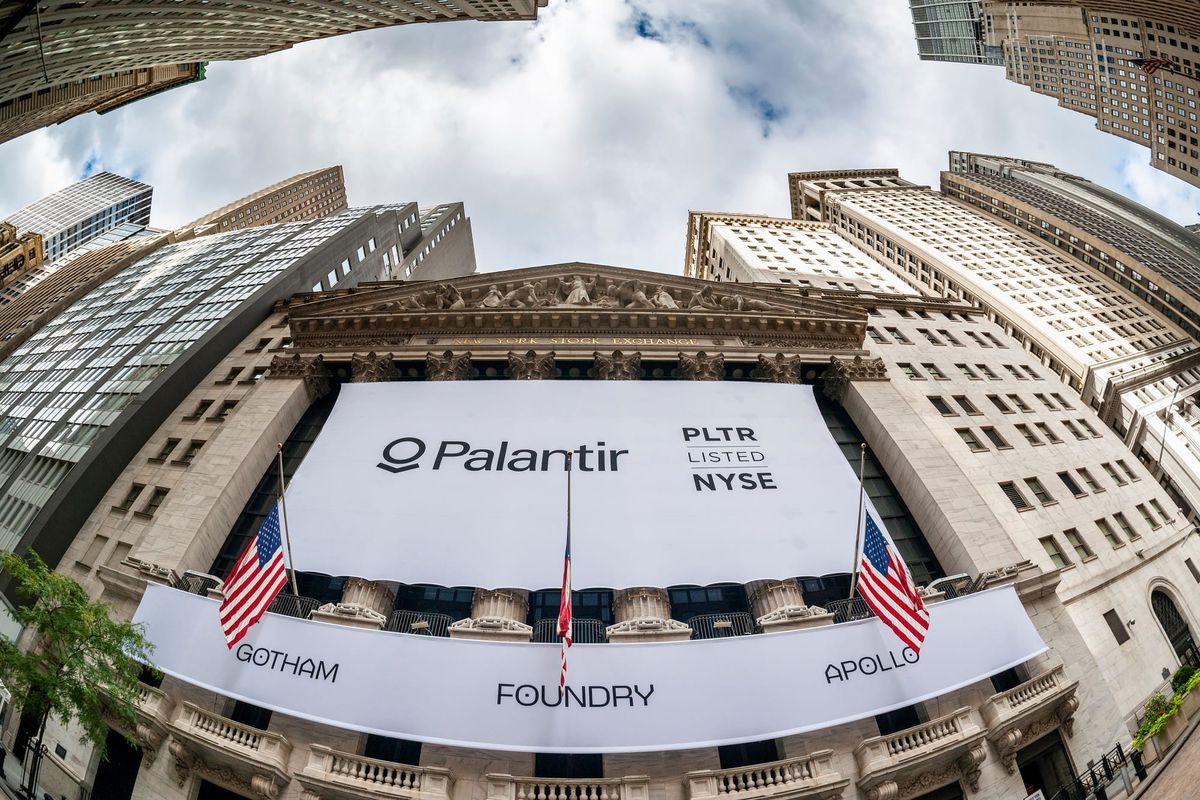
Palantir Wants To Be The Government

Getting banned from Elon Musk’s X for pointing out Palantir’s fascism has created more interest in my work.
Last week, I spoke with Emma Vigeland of the Majority Report about the Palantir manifesto and the company’s role in Trump’s fascist regime. You can watch the full interview below.
I also spoke with Cydney Hayes of the SF Gazetteer, one of the few journalists to write about my baseless suspension from X, for her piece on Palantir.
“Palantir is quickly becoming one of the most hated companies in the world, due to its open complicity with an authoritarian regime,” I told her. “They have a major public relations crisis.”
Here’s a gift link to read her story.
 Cydney Hayes
The word “fascism” gets tossed around a lot, often as a generic term for authoritarian or dictatorial. But it has a more specific meaning. I’m currently writing a piece that will explain why the Palantir manifesto is a clear expression of fascism. (Makena Kelly of Wired reports that “Palantir Employees Are Starting To Wonder If They’re The Bad Guys.” Spoiler Alert: Obviously.)
In the meantime, I explain some of my thinking in the Majority Report interview (transcript below).
Prefer audio?
- Listen to the Majority Report on Apple Podcasts
- Listen to the Majority Report on Spotify
Full transcript below
The Palantir Manifesto | The Majority Report with Sam Seder|Gil Duran Interviewed By Emma Vigeland
Transcripts may contain errors.
Emma Vigeland: We are back, and we are joined now by Gil Durán, publisher of The Nerd Reich, a newsletter about the tech authoritarian politics of Silicon Valley. Gil, welcome back to the show.
Gil Durán: Thanks for having me.
Emma Vigeland: Of course. So earlier this week, Palantir took out a full-page ad in the New York Times — or was it the Wall Street Journal? I forget which paper — about how they "stand with Israel." We knew that already. But they also published this so-called manifesto on social media, and I want to get to that in a second. Before we do, can you explain to people what Palantir is? It's talked about all the time — it's kind of this boogeyman — but its origin story, how it came to be, and really what role it's currently playing in American politics and in our economy.
Gil Durán: Sure. Palantir came into being after 9/11, when there was a lot of concern about national security, fears of terrorism, and the need for vastly increased surveillance of everything in the United States and internationally as well. It was funded partly with an investment from In-Q-Tel, the CIA's investment arm, but most of the funding came from Peter Thiel and his venture capital funds. He's a co-founder along with several other people, like Joe Lonsdale and Alex Karp, who was Thiel's law school buddy and is now the CEO and has been a part of it a long time too.
What Palantir does — they keep the whole thing kind of opaque, so it's hard to explain — but they're a surveillance technology giant with software that helps governments sort through, collect, and organize large troves of information on whatever their chosen targets are. It's a program that sits on top of other systems and helps them have more of an all-seeing-eye effect. That's why they chose the name Palantir. The name comes from The Lord of the Rings, and it's that little orb the evil wizard uses to see what's going on with the hobbits as he tries to take over the world. So they literally named it after a technology wielded by an evil, corrupted wizard in The Lord of the Rings. Think of it that way: it's the little all-seeing orb. That's what they want you to think of.
Emma Vigeland: Yeah. And their insistence on portraying themselves in this braggadociously evil, mendacious manner is unique. It's manifest in this manifesto, if you will. Let's pull it up here. From what I understand, it's basically a summary of Alex Karp's book — Karp being the CEO of Palantir, who we've played on the show before, a very manic and bizarre individual. A lot of this is just summarized from what he's previously written. But this is what they say the new Palantir manifesto is — their role in the United States.
The first plank: Silicon Valley owes a moral debt to the country that made its rise possible, and they have an affirmative obligation to participate in the defense of the nation. Number two — rebelling against the iPhone apps — that seems a little less consequential. Number three: free email is not enough; the decadence of a culture or civilization, and indeed its ruling class, will be forgiven only if that culture is capable of delivering economic growth and security for the public. Whatever. But one and four seem to link together. Number four: the limits of soft power or soaring rhetoric alone have been exposed; the ability of free and democratic societies to prevail requires something more than moral appeal — it requires hard power, and hard power in this century will be built on software.
We'll come back to this in a second, but those two seem to connect. And the fifth plank is about how AI needs to be used to develop weapons and military and national security technology. So this is them announcing publicly: one, we shouldn't be bound by morality, and yet Silicon Valley owes a moral debt to contribute to the national defense via surveillance; and also, we're going to use AI weapons. Are they going to do that for free, or are they going to take government contracts? I think we know the answer.
Gil Durán: Yeah. What's interesting about that first point is that the greatest threat to our nation right now is from the Trump regime, which is attempting to destroy the country from the inside — and Palantir is a major conspirator in that project. They are reaping billions in contracts, expanding their footprint like never before. To be clear, Palantir has thrived under Democratic and Republican administrations — something that really needs to change. But the country they're talking about defending is not the country we think of as the United States of America. It's this new authoritarian regime that's being brought into being by Trump, and which they plan to defend with their software violence.
The important thing to understand about this Palantir manifesto — which, as you said, comes from Alex Karp's book The Technological Republic — is that it rings all the bells of classic fascism. It is a call to arms for a group of chosen Silicon Valley elites to merge with the military-industrial complex, on a moral imperative to defend against an existential threat to Western civilization posed by inferior cultures that are invading us and weakening us, along with liberal elite decadence. This is fascism.
In addition, they call for Silicon Valley to get engaged with law and order and fighting violent crime to save lives — fascists always try to exacerbate fears around crime. And they call for a new respect for religion and the fusing of corporations with government. That's pretty much what Mussolini did when he created fascism: you fuse corporate, state, and religion. So without saying the f-word, they're winking and nodding and saying it other ways.
The thing is, this is what many of these venture-capital-funded tech companies are doing right now. Everyone's issuing some kind of manifesto about acceleration, about the need for more warfare and technology — and this is basically classic fascist rhetoric. They're all competing to be the new Mussolini, essentially. It should terrify Americans, and it should radicalize Americans, that these people are becoming so completely extreme while living off our taxpayer dollars.
Emma Vigeland: And it is notable that Palantir's technology has been integrated with ICE activities. You mentioned how Palantir started after 9/11, and that the CIA's venture arm invested in it. ICE is also an outgrowth of 9/11. The Department of Homeland Security is an outgrowth of 9/11. And viewing Palantir and its growth as an extension of the national security state that came out of 9/11 — many leftists, many people, warned that eventually these technologies and the rollback of our civil liberties would result in this being used on American citizens. It feels like Palantir is central in that project, as is its work with ICE specifically.
Gil Durán: Oh, definitely. It's part of the immigration machine. It's part of the war machine. It is completely bought in. Its entire fate depends on this increased surveillance model. They're also doing stuff in hospitals, like monitoring the work schedules of nurses. There's a large level of buy-in to this company right now.
One of the big problems is that the United States government is creating a company that now feels entitled to rival government power — to start issuing its own political manifestos. It's the hazards of privatization unfolding in real time. If the government needs some of these technologies, it should own those technologies. It should not have a company that now decides what the new political structure of the country is going to be.
Why aren't the CEOs of Lockheed or Raytheon issuing manifestos? I'm not saying those companies are good, but for the most part, in the past, you didn't have government contractors out there pushing radical political ideas of their own. Their job is to do what the president and Congress decide. They are contractors. So you have contractors acting like they're the CEOs of government, and this is very much the idea they have in mind: a privatization of government and a seizure of power through surveillance and military might. It's important to be aware of that. It has to become a political goal of all of us to destroy this company and disentangle it from our government.
Emma Vigeland: We had Rana Dasgupta on a few weeks ago to discuss his book After Nations, and he compared Silicon Valley and the growth of the tech industry to the East India Company historically — a private entity acting alongside and in conjunction with the imperial power of the time, but privatized, with its own incentives, and so powerful at this point that it can have more sway than even the most powerful nation states that supposedly have some sort of democratic input.
Gil Durán: And they talk about that very openly. Balaji Srinivasan uses the Dutch East India Company as a framework — returning to a world where these sort of corporate guilds have a tremendous amount of power. A big idea I've talked about on your show before is what they call the Network State: the creation of a new power source that is not national, that is not based on democracy or government power, that's based on pure corporate power. They explicitly talk about that, and everywhere we look we can see examples of them doing it.
I should say, too, that meanwhile, Palantir co-founder Peter Thiel has been traveling the globe talking about the Antichrist, saying the Antichrist will seek to establish a one-world rule through technology under the slogan of "peace and safety" — which sounds a lot like what Palantir is doing, as people have pointed out.
Emma Vigeland: Isn't he saying Greta Thunberg is the one ushering it in?
Gil Durán: He throws in a lot of words like that, but those are distractions. What he's really saying, if you read the whole speech, is that the United States is the cradle of the Antichrist, apparently because it's the cradle of what we call democracy — and that Silicon Valley should not help the United States spread democracy, but should find a way to decentralize this power. Basically what Karp is saying: make it privatized, and reverse what the country has traditionally stood for.
A lot of what these guys are afraid of is the fact that this is going to become a minority-majority country, and they fear what will happen to white supremacy when that happens. So that's the thread: these expressions of public political psychosis coming out of Silicon Valley. It's extremely concerning.
Emma Vigeland: Yeah. And as Matt just said off-mic — what a coincidence that these are all white South Africans who seem very obsessed with demographics. I just want to return quickly to what you said about crime — Silicon Valley coming out of San Francisco, where there has been this large-scale panic about homelessness and crime, and the insistence that crime was out of control when we saw a temporary spike during COVID and now have seen precipitous declines. The network state concept you've written about is about the privatization of government, as you say. They made those efforts within different cities — they funded an effort to recall Chesa Boudin in San Francisco. But it feels like their ambitions for the privatized surveillance state to combat crime aren't just limited to the cities where they were making billions. It's now about expanding that to the entire United States.
Gil Durán: Crime is a tried-and-true way to create anxiety about poor people, about poverty, to create racial anxiety. This goes back many decades. They're not creating anything new there. They're just saying they've got to supercharge it. That's what we saw in San Francisco at a time when crime was declining and crime rates were generally at historic lows across California, including in San Francisco, which is a very safe city. They created a moral panic around crime and were able to achieve their political aims by doing so.
I definitely think they want to deploy that strategy at a larger scale. Again, everywhere you look, this is the extreme right-wing fascist playbook being played out: creation of fear of the other, a need to centralize elites and wealthy people around a goal of purging the enemy. They speak about inferior cultures that don't contribute to the country. It's all very transparent, but they put it in this pseudo-intellectual format that makes it seem like they have some kind of high-minded philosophy, when it's really some of the ugliest stuff in our politics.
Emma Vigeland: My last question: how seriously should we take it? How much is this Alex Karp branding himself? How much is a way to attract investors by overstating their power? How concerned should we be about a manifesto like this? Is it PR? Is it bluster? Is it a mix of all of the scary things?
Gil Durán: I think it's a mix of all of them. And I would say, too, I think Palantir is starting to panic a little bit, because they're becoming one of the most hated companies in the world. People are now associating them with some of the worst abuses of the genocide in Gaza. So they have a massive public relations problem, and I think they thought this would somehow assuage that, but it seems to have only made it worse.
What we have to do is take it very seriously. These people mean what they say. They do mean to destroy our country and our democracy, and we have to organize against them in order to purge Palantir from our government, and from the planet, really.
Emma Vigeland: I really appreciate your time today, Gil Durán. You can read The Nerd Reich newsletter about the tech authoritarian politics of Silicon Valley — it's essential reading these days. Thanks so much.
Gil Durán: Thanks for having me.