
‘The ghost was right’

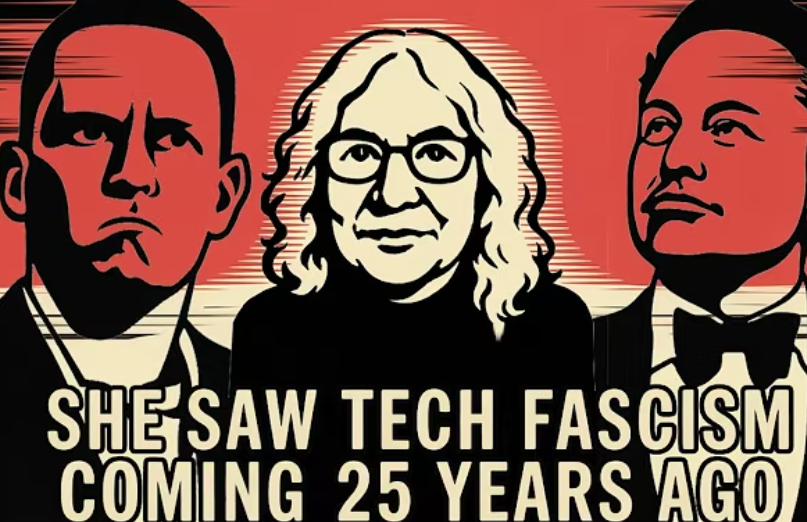
Last year, I wrote about Paulina Borsook, a rare writer/journalist who—early on— warned about the rising danger of Silicon Valley’s anti-democratic tendencies.
Next week, Paulina’s masterpiece—Cyberselfish: A Critical Romp Through the Terribly Libertarian Culture of High Tech—will be republished with a new foreword by me.
With permission, I am publishing that foreword below. Next month, I’ll host a live online Q&A with Paulina. So, please buy her book so we can discuss it!
Foreword to Cyberselfish (2026)
You hold in your hands a work of prophecy. Like most products of that cursed genre, it contains a warning that was largely ignored at the time of its publication. The disastrous results of this oversight fill today’s headlines and pose an existential threat to freedom and democracy.
Today, the United States is ruled by a fascist regime fueled and funded by the world’s leading purveyor of fascism: Silicon Valley. This partnership between MAGA and the moguls of tech took some long-time observers—and many renowned tech “experts”—by surprise.
But Paulina Borsook saw it coming.
In the 1990s, she chronicled the strange, sociopathic, anti-government politics of Silicon Valley millionaires. Soon, these men would morph into billionaires and become the biggest threat to democracy (and humanity) in the history of the world. While many journalists and writers of the era filled page after page with hagiography for the kings of tech, Paulina took a different approach.
Decades before Elon Musk declared war on “empathy” and plopped $291 million into Donald Trump’s reelection campaign, Paulina wrote of the “nastiness, narcissism, and lack of human warmth” emanating from the tech bro class. All the way back in 2001—long before federal contractor and welfare queen Elon Musk tried to dismantle the government through DOGE—she warned of tech’s “contempt for government when government had been so verrry verrry good to high tech.”
Early on, Paulina diagnosed the pathology at the heart of Silicon Valley, describing it as a “scary, psychologically brittle” mentality that “bespeaks a lack of human connection and a discomfort with the core of what many of us consider it means to be human.” Cyberselfish: A Critical Romp Through the Terribly Libertarian Culture of High Tech was so far ahead of its time that it remains fresh in 2026. To this day, few have written anything half as clear or relevant as what she wrote a quarter century ago. But few people were interested in this kind of brutal truth in the early days of the twenty- first century.
Despite its prescience, Cyberselfish largely marked the end of Paulina’s professional writing career. The journalism establishment of the 2000s had little use for a razor-tongued Cassandra incisively focused on the negative traits of tech’s wonder boys. Cyberselfish sold poorly; Paulina’s job opportunities withered.
Establishment journalism tends to reward failure more than foresight. Many writers who got Silicon Valley totally wrong went on to lucrative and distinguished careers, swishing between plum positions on prestigious mastheads. But some people are born for adversity, and such is the case with Paulina.
When Paulina was fourteen, a classmate shot her in the head with a Colt .45. Somehow, she survived, though the bullet shattered her jaw, blew out part of her skull, and left her with a traumatic brain injury, resulting in a neurodivergence that changed everything. She became, in her own words, a “ghost.”
Unable to pursue most careers due to her brain injury, she eventually drifted into technical writing, which matched her abilities, interests, and skills. She had grown up in 1960s Pasadena, in a New Deal family that believed in the ACLU and the social contract, surrounded by the engineers and scientists of Caltech and the Jet Propulsion Laboratory. That older generation of technical professionals—the ones who built America’s space program—had deep respect for the government investment that made their work possible. They had worked on publicly funded research and they recognized their debt to the infrastructure, education, and investment that taxpayers provided. They saw themselves as part of a larger social project, not as self- made men who owed nothing to anyone.
In Silicon Valley, Paulina realized that something had gone terribly wrong. These new tech millionaires were superficially similar to the Caltech engineers of her youth—smart and technically skilled. But their politics were unrecognizable. They displayed a violent contempt for the very government whose funding, infrastructure, and contracts had made their fortunes possible. They worshipped Ayn Rand and fantasized about a world where they owed nothing to society. They treated technology not as infrastructure—as ordinary as water or electricity—but as proof of their own exceptional genius and superiority.
Perhaps only a ghost—someone who had nearly died once and existed at the margins of society—could see clearly what others refused to acknowledge. The tech elite’s radical contempt for government seemed outrageous to someone whose life had been saved by the public schools, roads, and emergency services that venture capitalists would later dismiss as deadweight. Their worship of pure individual merit looked like insanity to someone whose disability meant she understood the necessity of human interdependence. Their dreams of a world as controllable and predictable as a computer appeared ridiculous to someone intimately familiar with the messy, unpredictable reality of a brain that had so improbably survived a fateful collision with a bullet.
Having built her life from the wreckage of tragedy, Paulina did not shy away from telling uncomfortable truths about powerful men. While others fawned for access to billionaires and worshipped at the altar of “disruption,” Paulina—outsider, rebel, ghost—looked past the TED stage and the Fortune cover and saw the extremist cult growing underneath.
We did not listen. The world might be a better place if we had.
But here is the gift, arriving a quarter century late and more necessary than ever: the book in your hands. Cyberselfish is the missing instruction manual for the catastrophe we are now living through. Every figure stalking today’s headlines—every government contractor billionaire dismantling an agency, every venture capitalist building a private city, every crypto mogul preaching against democracy—was already here in the 1990s, in miniature, waiting to grow. Paulina saw the seedlings, and she warned us what they would become if we let them grow. We didn’t listen, and now we reap the bitter reality Silicon Valley has sown.
Cyberselfish is no longer just a critical romp that flopped. It has become a crucial document in our history, an early map of the dystopian territory in which we now find ourselves fighting to survive.
The ghost was right. She is still here. And the truths she set down a quarter century ago are, at long last, ready to be heard. It’s too late to prevent what Paulina foresaw, but it is not too late to understand it, to name it, and to allow her clarity and her wisdom to inform our fight for the future.
—Gil Durán
Excerpted from Cyberselfish by Paulina Borsook. Copyright © 2026 Gil Durán. Published with permission from Tin House, an imprint of Zando, LLC.
- If you’re in the Bay Area, you can attend Borsook’s book launch next week in Oakland. Tickets here. See you there!
- Borsook was recently profiled in Mother Jones (with quotes from me). Click here to read “A Tech Prophet Finally Gets Her Second Coming.”
- Pre-order Cyberselfish wherever you get your books. Pre-orders make a huge difference! Use this Bookshop link to support independent bookstores and this newsletter.
- If you’re a B&N rewards member, get 25% off Cyberselfish when you preorder the paperback or ebook from Barnes & Noble from Wednesday 9/9 through Friday 9/11 using the code PREORDER25. Use this link: https://www.barnesandnoble.com/w/cyberselfish-paulina-borsook/1107432589?ean=9781638935797
Below is my interview with Paulina Borsook on The Nerd Reich podcast. With 255,000 views and counting, it’s our most-watched episode ever.