Financial Times Discovers the Network State Cult

The Financial Times is the latest mainstream newspaper to discover the existence of the Network State cult. In a story headlined “Tech elites are starting their own for-profit cities,” FT writer Hannah Murphy outlines the basics of the movement to create new tech-controlled fascist cities all over the world.
This once seemed like a fringe idea, and most major news outlets have ignored it. That is changing.
Writes Murphy:
But what was a fringe concept a matter of years ago is now attracting more interest as scrappy start-up chief executives and aggrieved billionaires contemplate the allure of tech-friendly havens unbound by legacy rules and regulation.
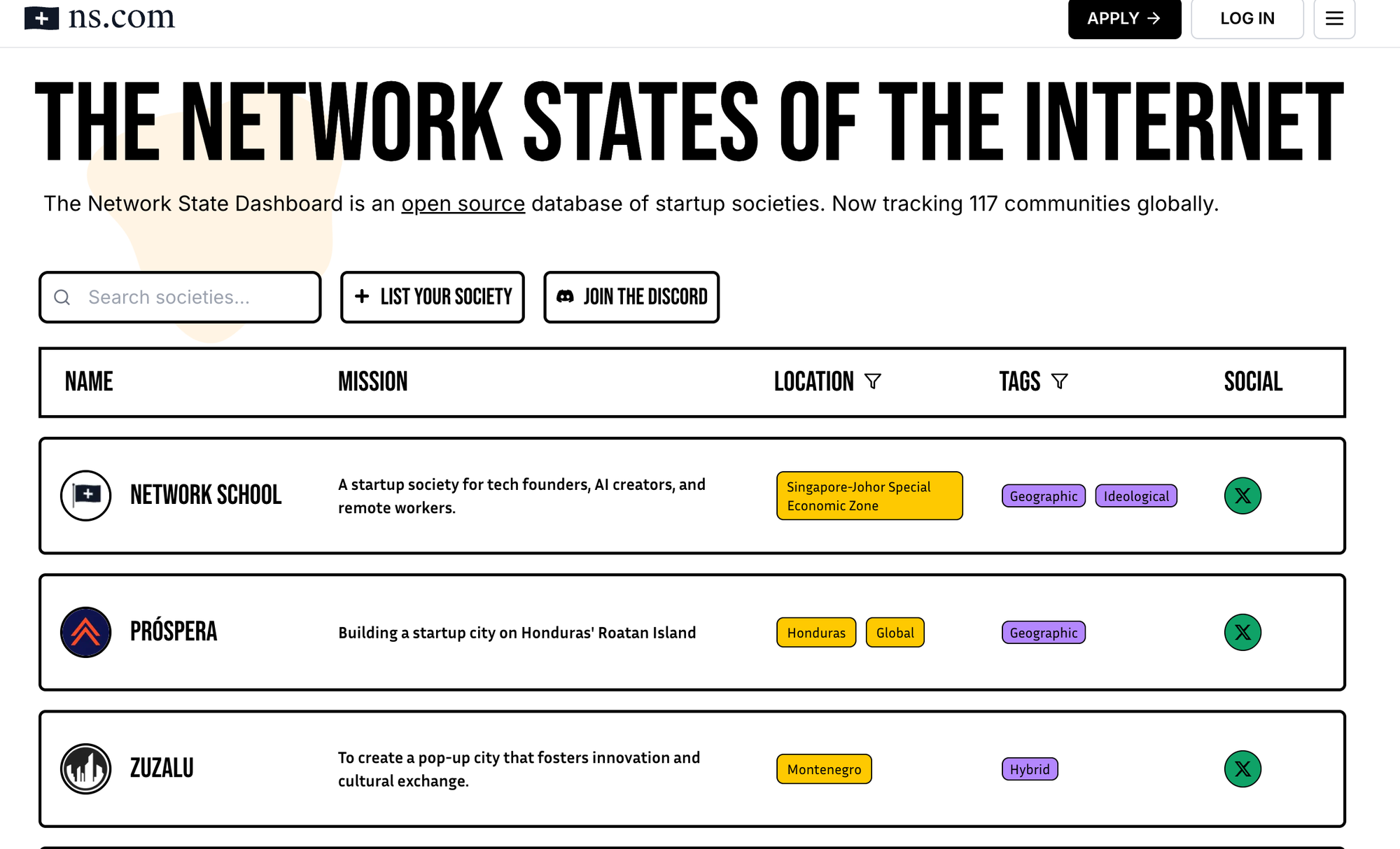
While some are aspirational, reliant on their founders securing hard-to-come-by special economic zone status, there are now about 120 “start-up societies” in the works, according to an open-source database shared by Srinivasan.
A few have received hundreds of millions of dollars in venture capital from funds backed by the likes of investors Peter Thiel and Marc Andreessen, OpenAI founder Sam Altman and Brian Armstrong, Coinbase chief executive.
The story whitewashes some aspects of the Network State cult. It makes no mention of Balaji Srinivasan’s fascist vision for a tech “Gray Tribe” that teams up with police to purge the Democratic “Blue Tribe” from San Francisco, or the fact that Srinivasan predicts the USA is headed toward civil war.
It describes the Praxis network state—funded by Marc Andreessen, Peter Thiel, and Sam Altman—as “whimsical and rebellious.” (Ignoring the fact that the Praxis website predicts the decline of nation-states and is coded with fascist messaging about restoring Western values.) It describes Praxis CEO Dryden Brown as “a homeschooled professional surfer with a penchant for Austrian economics,” ignoring his vicious anti-LGBTQ pride rant over the summer and his current role in spreading a debunked “white genocide” conspiracy theory about South Africa.
“Próspera shuns the ‘network state’ label,” writes Murphy.
Yet the project is listed on Srinivasan’s official Network State dashboard.
However, the story also has some gems. Murphy explains that the idea of the Network State can be traced back to Curtis Yarvin and his idea for corporate-ruled “patchworks.” (Many people miss this key point.)
And it has an amazing end paragraph, in which Thiel protégé Patri Friedman shrugs off concerns about colonialism and techno-fascism:
Patri Friedman initially pushes back on the notion of these projects as neocolonialist, declaring “most of our projects are greenfield”.
He pauses. “Although, in Africa, we are looking at land parcels large enough that there will be people living there, in which case we will offer relocation bonuses to pay for anybody who wants to move out of the zone.”
And what about fears that this marks the rise of techno-fascism?
“I mean, we are funding companies that will operate non-democratic cities,” he says, shrugging. “And if you’re not into that you shouldn’t move there.”
Click here to read the story. (Paywall possible)
It’s good to see major outlets like the venerable FT taking notice of this important story. This is progress, despite the soft focus. But the plan for these corporate dystopia cities is just the tip of the Network State iceberg. This is a full-stack fascist ideology with plans to scrap democracy and remake the world.