JD Vance’s Theo Bro Network: Silicon Valley Meets ‘God’
When venture capitalists start preaching and preachers start talking crypto, you know democracy’s in deep trouble.
Silicon Valley extremists and religious extremists are finding plenty of common ground these days. Both groups see themselves as destined to rule, they have similar strategies for taking control, and they are working with Trump to seize the institutions of democratic power.
Peter Thiel’s guru, Curtis Yarvin, calls these institutions the “Cathedral” and says they must be remade as tools of authoritarian power.
A powerful group of religious extremists calls these institutions the “Seven Mountains.” And they push the Seven Mountains Mandate, which calls for seizing these pillars of influence in society to remake the USA as a Christian nation.
Silicon Valley fascism and Christian nationalism both seek to build the same bleak authoritarian future. And JD Vance is the linchpin.
Welcome to the latest episode of the Nerd Reich Podcast. Today’s guests:
- Professor Matthew Boedy, author of The Seven Mountains Mandate: Exposing the Dangerous Plan to Christianize America.
- Kiera Butler, a national correspondent at Mother Jones who has written about the Network State and Christian Nationalist movements.
Listen →
Available wherever you get your podcasts.
Transcript below.
Thank You To Our Sponsors!
The Nerd Reich podcast is made possible by paid subscribers. If you can, please help us to keep this newsletter paywall-free in 2026. Click here to join 759 fellow readers in becoming a paid subscriber today!
Network State Meets The Seven Mountains Mandate: JD Vance, Charlie Kirk, The Rise of The Theo Bros
Transcripts may contain errors.
Gil Duran: Silicon Valley venture capitalists are now quoting scripture—and Christian nationalists are now pitching network state cities. So you know things are getting bizarre. But here's the thing: It makes perfect sense because it's a strategy, and it's spelled out in black and white.
In his book, The Network State: How to Start a New Country, Balaji Srinivasan identifies evangelical Christians as followers of the so-called "Red God"—right-wing Republicans who will ally with his gray tribe of tech billionaires.
Together, they'll crush Democrats, democracy, and the nation state. It's a clinical, almost contemptuous framing of Christianity as a political weapon. But it works because both Christian nationalism and tech fascism share the same playbook: seize the pillars of democratic society and replace them with parallel alternatives, all run by authoritarian elites. The Christian nationalists call it the Seven Mountains mandate—taking over government, media, education, business, arts, family, and religion.
The tech authoritarians call it replacing the cathedral with parallel institutions. Different language, same goal: elite minority rule and the end of democracy as we know it. Today on the Nerd Reich podcast, we expose how this alliance actually works.
I'm joined by Matthew Boedy, author of the definitive book on the Seven Mountains mandate, who explains how figures like Charlie Kirk and other religious extremists have been systematically organizing this takeover.
And Mother Jones reporter Kiera Butler takes us inside Highland Rim—a proposed settlement on the Tennessee-Kentucky border that's basically a network state for Christian nationalists. It comes complete with crypto and investments from the same venture capital networks funding Silicon Valley's dreams of exiting democracy.
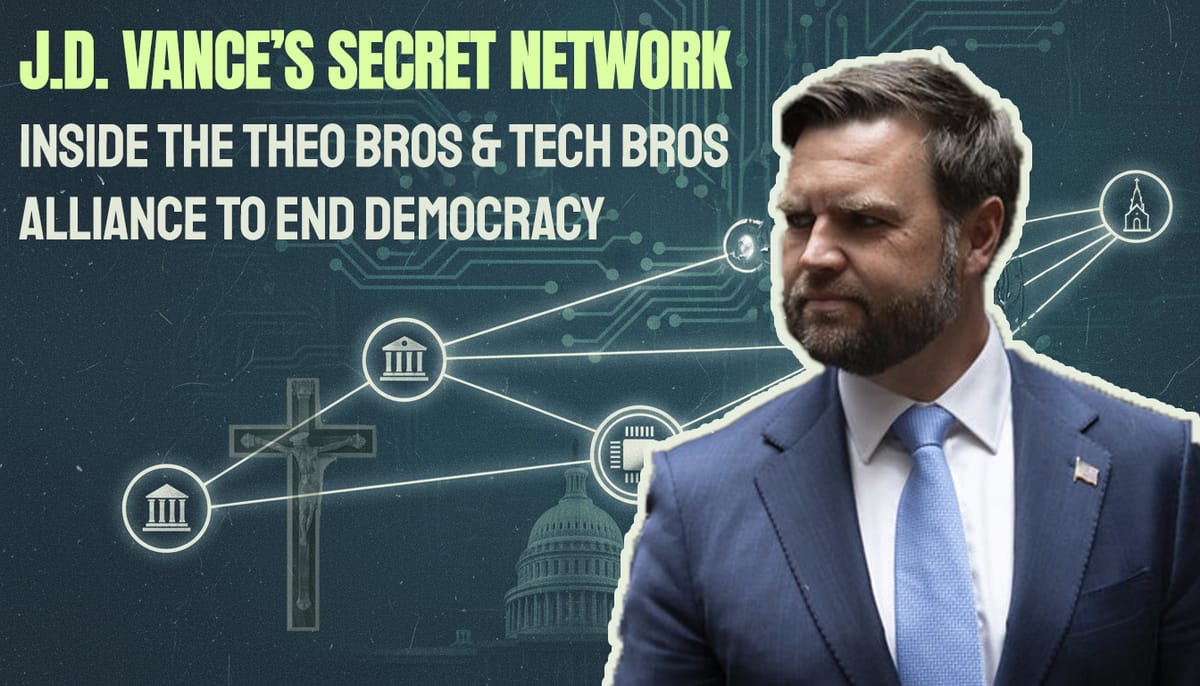
She's tracked how this convergence flows through figures like JD Vance, who sits at the nexus of the Theo Bros and Tech Bros—Rockbridge Network and American Reformer, venture capital and Christian nationalism.
It's an unholy alliance of Christian theocracy and tech fascism that sees the destruction of democracy as a high moral calling. The question isn't whether they're working together. They are. The question is whether the American people will wake up to the threat on their doorstep.
Part One: Matthew Boedy on the Seven Mountains Mandate
Gil Duran: Matthew Boedy, thanks for joining us today on the Nerd Reich podcast. So let's start with some background about your focus and your work. In 2016, you were placed on a Turning Point USA Professor Watchlist, which led you to become an expert on this particular area of Christian nationalism and the threat that it poses to democracy. So tell us about that experience, how it changed your life, and how it puts you on the path to your book, The Seven Mountains Mandate: Exposing the Dangerous Plan to Christianize America and Destroy Democracy.
Matthew Boedy: Indeed, it's been a crazy couple of years and even the last few months, obviously, since Charlie's death. So in 2016, Turning Point—which at that point very few people knew who that organization was—they decided to go viral with a list of professors they didn't like. There were about 100 originally that they put on the list and I was one of them because I wrote an opinion piece for the local newspaper advocating against allowing concealed firearms on college campuses, which is now a law in Georgia. So we lost that battle.
And to be honest with you, I wrote that op-ed, I forgot about it, and then we lost. And then months later, Turning Point puts me on a list. And to be honest with you, I didn't pay much attention to the list at that point either. And many people, I think, were much smarter than me at that point—noticing not just the professor hatred on it, but the McCarthyism and all that.
And so as time went on, certainly being on a list like that draws attention to you. I'm a professor at a school very few people have heard of in Georgia and I teach English, which is not a big subject. So being on the list gave me some identity. And then I started writing about Charlie Kirk. It became a hobby for me, you know, starting a fact-check blog and trying to keep up with all the things he was saying. But to be honest with you, it was a hobby.
So around the time the pandemic hit, he and Turning Point switched from a more libertarian, we'll say, chamber of commerce conservative—"national debt" kind of mantra—to a Christian nationalism theme. And that put it squarely in my research agenda as a professor. I knew exactly what they were saying. I understood what Charlie was saying when he came out to CPAC in 2020 and said that Donald Trump was the first president to understand the seven areas of cultural influence, which I'm sure we'll go through the list here.
So it became less of a hobby and more of an urgency for me to not just write a fact-check blog, but to write many things to make people aware of Turning Point. Even in 2020, people were kind of unaware. They thought Charlie was just merely a college campus organizer or college campus debater. I mean, he had a big podcast at that point, but really it took a couple of years for Turning Point to expand from those things. So yeah, I've become the expert on Turning Point and Charlie Kirk. And as you imagined in the last few months, I've done hundreds of media interviews about the expansive nature of Turning Point. So I got started by—some people asked me, why did you start on Turning Point? Well, they started on me first.
Gil Duran: That makes a lot of sense. You were sort of thrust into it, as we all have been in this era where we're having to learn about a lot of things that might have seemed like strange ideas before, but that have suddenly become real and palpable threats to democracy. I'm assuming that a lot of our listeners and viewers have not heard of the Seven Mountains mandate, or if they have heard of it, they don't really know much about it. So let's get into the basics of that. And I'm going to start with the first line of your book.
The plan to Christianize America began 50 years ago with a vision from God. There's been a lot of strange visions, biblical visions going around lately. I've done a lot of writing about Peter Thiel giving his sermons on the Antichrist. And that's what really brought me around to your work—realizing the symmetry between some of what I'm writing about in the tech world and what's happening over in the Christian nationalist world, and both are now starting to very clearly merge.
The founders of the Seven Mountains Mandate believe they received a divine message to Christianize the United States. And they would do this by seizing control of the country's main institutions as part of a massive spiritual war against demonic control—to clear these areas of demonic control and bring forth the kingdom of God. And I want you to unpack that for us. But first, who were the founders of the Seven Mountains Mandate? What were their visions? And what are those seven mountains?
Matthew Boedy: The second line of the book is also important: "Or so the legend goes." Two people—Bill Bright, who was the founder of Campus Crusade from California, and a guy named Loren Cunningham, who founded a global mission organization called Youth with a Mission—were friends back in the '70s. And not just starting out—they started their organizations in the '50s. So they were trying to expand and really go beyond college campuses.
They got together in August 1975 in Colorado. One was on vacation, one was giving a speech, and they wanted to talk with each other. And the legend, the divine revelation message goes that each of them got a list from God of these seven areas that they should Christianize. One came in with it written on a piece of paper, and the other one came in with it typed, and they gave it to each other at the same time. And it was a "divine appointment," as Loren Cunningham calls it.
So this list though of seven places is not a divine revelation. These lists—if you were to think of the cultural institutions in our nation, you could probably name all seven without blinking. They're in textbooks. They didn't need God to tell them these lists. But the idea that they wanted to—one, that these areas were already under demonic control or under anti-Christian forces, that's part of the Seven Mountains mandate. And the other part of course is taking them back.
Really it began with this idea of what do we do with the alumni of our two groups. Bill Bright, being Campus Crusade, had a bunch of college students who were going into the world. What do you do with those alumni? And the same thing with Youth with a Mission. These are teenagers sent around the world to spread the gospel. Once they come back, what do you do with them?
And so the idea was to, in some manners, try to find pathways for them to operate. So they wanted to influence—and I want to emphasize that word, influence—America for Jesus. As time went on, this list became more prominent with spirituality and spiritual warfare, became more—less of a list and more of a mandate. And so that's why it became known as the Seven Mountains Mandate.
So the list of the seven—I always leave one off, so I'm gonna try to list them here: the Mountain of Education, the Mountain of Government, the Mountain of Religion, the Mountain of Family, the Mountain of Business, the Mountain of Media, and the Mountain of Entertainment. The metaphor of the mountains came several years later. They called them "areas" or "spheres," but it took a couple of decades for this thing to spread and eventually became the Seven Mountains after a guy named Lance Wallnau—who was famously writing about Trump a couple of years ago—met Loren Cunningham around 2000, and Loren Cunningham had shared with him this list.
And Lance was like, "I've never heard this before." So he was looking for an idea to pitch his own ministry. So he came up with this metaphor of the mountain. So he's often known as the father of the modern Seven Mountains movement. But the two people who came up with the list are Bill Bright and Loren Cunningham.
I want to mention, I guess, a fourth person. His name is Francis Schaeffer. He was an American theologian, writer, big into the culture wars in the '70s and '80s. And he is also credited with giving this list a lot of cache. Now he didn't—he was not at that meeting in August 1975. But these people, these other two people latched onto him because in the '70s and '80s, he was much bigger than these other two people. So they often suggested that he was part of the list or he came up with his own list.
So Loren Cunningham, Bill Bright, Francis Schaeffer, and Lance Wallnau are the group of people that can be credited with this list and they spread it through different means. But the idea is that there are demonic forces, anti-Christian forces who control these areas—individuals who are anti-Christians, but also institutional powers that need to be retaken for Jesus.
So as you can see, some of them are pretty straightforward. Mountain of Government—electing people to office does not just mean electing them to the federal, you know, Congress and president's office, it's also state and local. So once they get into office, implementing Christian policies. Now the other mountains are much of a long game. The Mountain of Education is a great example. For decades now, conservative Christians have been trying to implement voucher systems or taking public money to pay for private schools, to getting people out of public schools because they believe they're demonic. But now they want to go back into public schools and take them back over.
So it's been a long game for several of these mountains. But now I believe with the rise of Turning Point USA, Turning Point has become the indispensable organization for the Seven Mountains mandate. They have spread themselves, expanded themselves in the last couple years to each of the seven areas. There's an arm of Turning Point for each of the Seven Mountains. And that's why I write in the book that Turning Point's the heir to Loren Cunningham and Bill Bright and Francis Schaeffer and Lance Wallnau.
Gil Duran: So the idea is to Christianize the country by seizing the pillars of influence and turning them into this evangelical Christian nationalist movement, making them the powerful influence of society. And in the work I do on the tech fascists who are trying to gain power under Trump, we have this guy, Curtis Yarvin, who has this idea called "the cathedral," which is that there are these certain institutions of society that are the basis of democracy. And not only that, but of communist control of the country. And what we must do is purge the communists and seize control of the cathedral or break it down and rebuild it as something else.
So it's interesting to me that Yarvin uses the metaphor of a cathedral of democracy that has to be torn down and replaced, whereas the people you're writing about—the Seven Mountains mandate, the Christian nationalists—want to actually impose the church on top of the state to make the state part of the church, right?
Matthew Boedy: Yeah, I want to point out the cathedral image obviously is kind of Catholic and maybe some Protestants, but the people involved with the Seven Mountains group is charismatic, evangelical. They don't have cathedrals or use the word cathedral a lot, but they're very interested in making the church the center of America. Some people in the group call it making the church "the command center" to run the culture.
And very specifically, it is a minority movement on purpose, and this is why it's anti-democratic. It's a minority movement because they want to install a minority of people to run these institutions. So when I say Christianize America, we do not mean to evangelize, to make the majority of people claim Jesus as their savior. We're talking about a minority movement on purpose because they believe they have the truth.
So back to the cathedral thing—it is about the church, it is about religious disruption of society, if you want to use a tech word. It is about apocalyptic thinking, that is, changing things very fast, perhaps with a divine power, but also doing it in such a way that the majority of the people don't follow it or don't want it.
Gil Duran: You know, Steve Bannon likes to say that he's a Leninist, right? And if you look at what he means by that, the idea being that you need an elite vanguard that is pure and true believer to take over and run things. And this is why you get authoritarianism with communism, right? It's this idea they seem to basically have adopted that same thing. With the tech guys, they see this rule by elites—democracy is over. We can't let everybody decide. We need to impose from the top down what the system will be. Basically they're talking about theocracy.
So if it's a minority movement, why should people care? Explain to us why a movement that is so minoritarian has power. Where do you see it popping up? Why should people be afraid of this?
Matthew Boedy: Yeah, so in a democracy, right, we think the majority rules, but there are protections for the minority. But the Seven Mountains mandate specifically says, and Charlie Kirk said this before he was killed, right: "We're not a democracy, we are a republic." And that republic has values and traditions and things that should be in place. And the only way to keep them in place is this elite that you're talking about. So they may be the minority, but once they have power—perhaps gotten through democratic means of being elected—they will use that power in anti-democratic means. So that's why we should care, one.
And then two, the people that don't agree with them, and this is the majority of the rest of us, will lose many of our rights. So in a republic, the First Amendment may not apply. Charlie Kirk has said in the past that the First Amendment and the founding fathers' idea of the First Amendment was not a religious pluralistic society. It was so that the federal government would not choose between Protestant sects, between Protestant, Baptist, Methodist, things like that. And at the state level, there was no freedom of religion. States could decide that they wanted to be a Christian state.
So very much if that comes to pass, you will lose religious pluralism, the ability perhaps to practice your religion. But also the interesting thing about the Seven Mountains and the way that it has changed over the years—it becomes much more aggressive, much more militaristic and more toward the end times that we have to do this now and we have to do certain things now to win. And one of those things often is silencing, putting away, erasing voices of people that they don't agree with.
If you think about the Mountain of Family, for example, that's traditional definition of family—men and women marrying, having kids at a young age. And that means of course eliminating a lot of other voices. So I write about Turning Point USA as not just saying these things on a podcast or on the radio show—they're out ambushing people at a Walmart in Nebraska who is a transgender person. They're out ambushing professors at Arizona State who go to drag shows. They're protesting drag queen story hours at libraries.
So they very much try to take the fight back in the culture war that they believe Christians have not fought. So their pitch to Christians is: you've been passive, you've just been interested in the gospel, we need to fight back because we're losing our culture, our country. And that's very much why everyone should care about it. It is not just minority shrieking. They very much want to act in many ways.
Gil Duran: Who are some of the most prominent supporters who have power?
Matthew Boedy: House Speaker Mike Johnson is an advocate of the Seven Mountains mandate. So you can see obviously a lot of power that he has. Now, if you think about the president, you know, I did say Charlie Kirk came out and said that Donald Trump is the first president to understand the seven areas of influence. Now, I don't think he understands the seven areas of influence, but there are people around him, especially his evangelical Christian advisory board. Paula White—Kane, his female advisor from the first administration and really popular now in the second administration—is also an advocate of this.
So there are many people around him that will push him in directions that he initially did not want to go. And Charlie Kirk was certainly one of them. He was a political kingmaker. He obviously was very close to the Trump family and all members of the Trump family. And he pushed along with JD Vance, many policies that the Seven Mountains mandate group would agree with.
So JD Vance is a second one. Now he ties in more with the people you've mentioned, being Roman Catholic, not being evangelical. But if you tie the nerd reich people you've been talking about with the evangelical charismatic Charlie Kirk group you've been talking about, that is a very powerful base of people who individually may influence the individual president. There's a survey in the book done by some scholars who said that, I think, 35% of Americans would advocate for or agree with specifically the Seven Mountains mandate. They put that into a survey.
Gil Duran: The stuff you're talking about—you mentioned JD Vance—he does seem to be a bridge between the worlds of religious extremism and the tech world. Now he chose to be one of these sort of converted extremist Catholics who is—I mean, I was born Catholic—so you get these converts who are suddenly more aggressive and militant than anyone else who's actually been a part of the religion since birth. And that's always odd. There's a lot of jokes about how it's the Catholic converts who want to quote all these Popes from 500 years ago and find the most arcane things to justify their extremism rather than maybe paying attention to the words of Jesus Christ, which are very far away from this kind of warlording and bigotry that they seem so fond of.
But it does seem to me that what's coming together is a sort of coalition of people who have very similar ideas. And the core idea being that democracy is outdated and it's not going to get them to where they want to go. That is very much what Peter Thiel's Antichrist speech is about. You know, he talks about the work of Carl Schmitt, who was a Nazi philosopher who said that politics is mainly about the friend-enemy distinction. So they seem to be forming the friends on the side of the people who are using apocalyptic religious moral justifications to fuel their anti-democratic schemes.
That to me is very concerning and very telling. And maybe there needs to be an eighth mountain, which would be the technology stack that they're adding with crypto, surveillance, defense technology, social media, which is helping them sort of achieve all of this because these guys have that on their side—or so they think that they can control the technology, they can create the money. You know, do you run across these tech guys at all in your work or are they mostly staying away? 'Cause I know there's also some tension between the more evangelical Christian nationalists who can see very clearly that these tech guys are actually pretty damn godless, you know, and they're about things like transhumanism and they're not exactly lifting up the words or the ideas of Christ.
Matthew Boedy: Charlie Kirk pushed a conspiracy theory about transhumanism and the ideas of that, so I would not think that he would go along with any version of that. But I think he was a bridge between these people. And now that he's gone, we see these differences coming into much more clear focus. I think that Charlie Kirk was an evangelical whisperer. He spoke their language, but he was also able to work at the level of not just Silicon Valley and big donors, but also the level of JD Vance in terms of politicians and donors and things like that.
So I think that if he were alive, he would be doing that more. So I think this division will stay with us for a while. So there's not necessarily a battle of who's going to win, who's going to have influence. They're both going to have influence. But I do think in terms of like the Seven Mountains mandate, the history of it shows me they've always tagged along to bigger ideas and bigger people. As I mentioned, Loren Cunningham and Bill Bright working with Francis Schaeffer, but all these other people tagged along to issues and ideas and made it part of the Seven Mountains.
The Mountain of Business is a great one. They tagged along with capitalism and free markets and made that a spiritual idea. So they'll continue to do that. And I think this is one reason why we'll see they won't be in competition so much as working together.
Gil Duran: And it seems this is an interesting part about the Seven Mountains mandate—is that it's not some organized thing where there's like one leader. It's more of a stochastic movement. I've seen it described as like a meme more than an organized thing. It's sort of like mimetic warfare. People might agree with it and espouse it without even knowing what it is fully. This is different than traditional evangelical beliefs, right? It takes a different path. How would you describe the difference between normal evangelicals and people who have been radicalized into the Seven Mountains mandate? And what's the relationship to the New Apostolic Reformation movement?
Matthew Boedy: I think the difference between the Seven Mountains people and what we call traditional evangelicals is that traditional evangelicals are just concerned with the gospel—that they're called evangelicals because they evangelize. So the Seven Mountains people will go to this group and say the gospel is more than just the four spiritual laws from Bill Bright or more than just the words of Jesus in the New Testament—that we need a Christian culture to evangelize better.
And that goes back to the majority versus minority thing. They're interested in the gospel, the Seven Mountains people, but they're more interested in the institutional level. So if you think about evangelicals working at the individual level to convert individuals, whether one-on-one or en masse crusades like Billy Graham, the Seven Mountains people work at the institutional level. So they're not exactly at odds, but at the same time, there are some theological differences there.
And I think also with the NAR, that is a group named by Peter Wagner, who was definitely a founder, a father of the Seven Mountains movement. And it's a self-proclaimed group of apostles and prophets. They also though, one of the things they did early on was attack churches—like denominations and groups—"you aren't doing church right, you aren't being Christian enough, you aren't spreading the Seven Mountains," if you will. So they form their own networks.
Now these networks are very large and the NAR is a global organization. So the Seven Mountains is a global idea. By doing that, they set themselves up as—it makes it hard to link with evangelicals. So they've been spreading among charismatics. There is some Catholics, Seven Mountains people, but I think really the idea is reenergizing the generations of people who were brought into politics by Jerry Falwell and the Moral Majority—their children or their children's children—and saying, we need to do this again because we haven't won all that we want to win.
And that's really been the route that Charlie Kirk took—speaking to charismatic churches, speaking to evangelical churches. And I think that while certainly Charlie had a bunch of NAR people speak at Turning Point events, there was no mention of NAR. They didn't name them as New Apostolic Reformation people. They just allowed them to speak. And one of them, of course, is Ché Ahn, who is now running for governor of California.
So they kind of smoothed over any connection with them, but they were always linked with them. And I think also because of the dispersed nature of the network, you needed a group or a person like Charlie Kirk to be that hub. And this is why I suggest that Turning Point is the heir to this NAR group. They were able to bring everybody in and train them, organize them—not just politically, but socially and culturally, doing biblical citizenship training—and then spread them out again. So they were really the workhorse of the organization. Turning Point is still the most important organization for the Seven Mountains and I think it will continue. I think it will thrive.
Gil Duran: So it's really a full-on strategy, right? To seize these pillars, but also with Charlie Kirk to reach young people and activate them at a time when religion has been on the decline in the United States, right? It's an attempt to reverse that trend and not only to get people into religion and Christianity, but into a radically politicized version of it. And Charlie Kirk was really the main figure there and he was killed—was it a couple of weeks before your book came out?
Matthew Boedy: Yeah, so he was killed on the 10th of September. My book officially came out on the 30th. But to be honest with you, it was in people's mailboxes that day that he was killed. Many people reviewed it online going, "I got this in the mail" and blah, blah, blah. So it's been a strange time.
Gil Duran: Tell us about his evolution. He wasn't always so overtly into this religious Seven Mountains type of approach. What changed and when did he come into the fold?
Matthew Boedy: I think the best way to describe it is he met Rob McCoy. Rob McCoy is a former megachurch pastor from California, former city councilman—he ran for state senate. He was a prototypical Christian nationalist pastor trying to influence politics from the pulpit. By happenstance perhaps or by targeting, he met Charlie Kirk in 2019.
At that point, this is eight years—or seven, if I do the math correctly—of Turning Point's existence. They started officially in 2012 when Charlie graduated high school. For those seven years, their first big project was "Big Government Sucks." Their next project was ending the national debt. They did these campus tours. They did the "Debate Me, Prove Me Wrong" campus tabling events. And they were mainly limited to this college student conservative grouping.
What Rob McCoy convinced Charlie was that you could take his evangelical faith, which he's always identified as that, and expand it into politics. A year earlier, before they met, Charlie had said, "No, I don't mix my religion and politics. I make secular arguments for my political policies because America is a secular nation." A year later, after talking with Rob McCoy, he's now saying things like "America is a Christian nation. It was born a Christian nation and we should have Christian policies."
So you can see the influence of Rob McCoy. It didn't take that much for Rob McCoy to convince Charlie to make this turn, even though it seems like a 180. While personally Charlie did turn from advocating against religion and politics mixing to advocating for it, he also saw it—it was presented to him as a tremendous business opportunity for Turning Point. It expanded the audiences and markets of Turning Point significantly beyond the college students into churches now.
And not just churches with young people, but churches of all ages. If you go to a Turning Point event that they have in Arizona or Florida, I mean, it's majority of people over the age of 22. Rob McCoy presented this as a way to expand Turning Point or get his message out to all these people. He introduced him to many charismatic pastors or pastors in his denomination. And it just kind of snowballed from there.
I think that also Charlie's close relationship with Donald Trump helped out immensely. You know, he was not an early supporter, but he jumped on the train pretty quickly in the first administration. By 2020, when the pandemic hit, Donald Trump had appeared at Turning Point events several times. I think he's done it 30 times now since he initially did it. I think the combining of Donald Trump's presence and power and all the people around him with the new audiences and the new markets just made Turning Point what it is today.
Gil Duran: In my work, I've increasingly come to think of the people I write about—whose version of the Seven Mountains mandate is called the Network State or the Cathedral—they have a few names for it. As a cult, you know, a small group of people with a really radical belief system, but with also the power to spread those beliefs. And, you know, often things that start small can become a lot bigger. So we do have to watch smaller movements as they grow because that's how a lot of things happen. The American Revolution, Christianity itself was a small cult for a long time and one probably would have not thought 2000 years ago that it would become a major world religion. So things do grow and become bigger.
One of the ways that the Seven Mountains mandate and the network state culty tech fascist stuff I write about has become very real in the past year—or in this year 2025—is through Project 2025. And many parts of the Seven Mountains mandate are recognized or made real in Project 2025. How did that happen? And where can we see Seven Mountains mandate type of thinking in Project 2025 and in the Trump government?
Matthew Boedy: I do say that Project 2025 is one of the Seven Mountains. It's certainly the Mountain of Government. As you know, the Project 2025 is this list of everything that can be done at a cabinet level agency in the second Trump administration, mainly sponsored or written by the Heritage Foundation, but Turning Point certainly was—its name is on that. So the Heritage Foundation has been doing this for a while.
And I also suggest the Heritage Foundation is a Seven Mountains movement, but it mainly focuses on just two mountains—the Mountain of Government and kind of the Mountain of Family, conservative social causes, maybe the Mountain of Education. But Turning Point's doing all seven mountains at once.
If you think about Project 2025, it aims at the federal government. So Turning Point's "Big Government Sucks"—they want to reduce the size of the federal government, not just its budget, but reducing cabinet level agencies, ending the Department of Education. These are all Turning Point goals, but also Project 2025 goals. And the reason they want to do that and the reason it is, say, a Seven Mountains goal is that you want to give power back to the states so they can enforce their idea of Christianity. It's much easier that way if you don't have that.
That said, Donald Trump is a wrench into that because that is a policy idea that really takes the power away from the federal government. But Donald Trump comes in and says, "Well, I alone can fix the government." So they had to pivot a little bit. I think Project 2025 is certainly could be done by any type of Republican and conservative president. But with Donald Trump, he breaks it much more quickly and wants to do it in a much more reckless fashion than another president might do it.
So he is certainly breaking down the government, but also suddenly he is the center of power, the influence. He takes all the oxygen up in the room. So the Seven Mountains mandate kind of pivoted with Lance Wallnau suggesting that Donald Trump is this new version of an Old Testament King. He is the guy that's going to restore our culture. So they have both the individual working and the policy working. And this is what makes, I think, the Seven Mountains mandate the indispensable concept behind the second Trump administration.
Gil Duran: One of the interesting things you do in your book is you argue that January 6th wasn't just a reflection of lies about the election, but also the decades-long influence of the Seven Mountains mandate. Tell us how the Seven Mountains theology created the conditions for this violent insurrection at the U.S. Capitol.
Matthew Boedy: Over the years, the Seven Mountains people made—and this is the NAR apostles and prophets—made predictions about what was going to happen. There's a couple of old predictions about Donald Trump becoming president. There's many predictions, of course, about winning the election in 2020, which they did not. The more predictions and prophecies that they made raised the stakes of that day because everything was centered on, of course, undoing or not allowing the vote to happen.
Ché Ahn, who I mentioned before, gave a speech on January 5th in Washington, D.C. about "God's going to win this election for us or change the vote tomorrow." So they very much bring spiritual power, bringing divine, not just mandate, but divine blessing to what it is they're doing. So you have Donald Trump saying, "Bring everybody to Washington, it's going to be crazy." You have everyone who is both a Christian nationalist and a patriotic person and Donald Trump MAGA people, and they're all energized by this religious fervor that we cannot stop until we've won.
And that theme really dates back to the beginning of the Seven Mountains mandate. Over the years, the different seven areas were tried and sometimes they had victories, but each time they lost, they raised the stakes, not just rhetorically, but also in terms of action—"we need to do something different the next time." So when you get to Charlie Kirk, he has raised the stakes so much. We're talking about good and evil. We're talking about half the country being demonic. The divide, the culture war being so pitched that on that day, they had to act in such a way as to go after the Capitol because there was nothing else that they could do.
I write about in the book a guy got arrested that day, a pastor, a youth pastor, who was in the Capitol that day. And he does a video, live video from the Capitol rotunda amidst the smoke. And he talks about why he's there. And then he talks about the gospel and spreading the gospel. Then he says, "That may not be enough. Sometimes we have to break down the doors." And he didn't mean that metaphorically. Obviously, he had gone into the Capitol. So you can see a type of religious fervor combined with Donald Trump's lies about the election, combined with years and decades of this kind of "we're not winning enough" really brought the insurrection to bear.
Gil Duran: We live in a time when American democracy is under attack, not by just one group, but by different groups that all have the same idea, which seems to be that democracy can't survive, mostly because they're in the minority and they can't impose their will or get their way in a democratic system. You know, this all ties into also white supremacy and the idea that, you know, minorities are going to become the majority in the 21st century. And so there's this sort of panic to find a way to rule society that doesn't necessarily involve everyone having a vote.
That, in the work that I do, seems to be a lot at the root of it. Also, if religion is on the decline in the United States, you get farther and farther away from people wanting to live in a Christian nation. So instead of trying to find a way to win in the democratic realm, it seems like a lot of energy is being concentrated right now on finding ways to exit democracy using captured influence, right? They may want to keep the country, keep dominion over the country.
And this is where the tech bros also merge because they don't want regulation. They don't want government. They don't want law. They view that actually as the religion of democracy—having all these rules put on wealthy people. So it does seem like we're under a concerted attack. It's not totally organized. You know, some people think it's all—there's a big plan and it's all mapped out. I think there are some divisions between these groups. There's some disorganization.
Also, I don't know what the dog would do if it caught the car because it's a lot to try to govern, you know, hundreds of millions of people. There's a lot at stake. The economy—if the United States was no longer a democracy, would it be successful or would it just fall down and become a banana republic like so many other countries? And the tech bros are actually okay with that because they want to escape into these zones where they'll be free from all of this and where they will no longer be governed by anyone except for themselves.
But it seems to me that with the story that I'm covering, which is getting a little more coverage now than it was last year when I thought people should have known about JD Vance and Curtis Yarvin and Peter Thiel and the crazy stuff that they say—and with what you cover—it doesn't seem like the coverage is commensurate to the threat and the importance of this issue. If these guys were Muslim or Black, I think the press would be paying very close attention and there'd be investigations, there'd be a lot more scrutiny on it, you know.
But instead it seems like there's a lack of interest from the mainstream media in really putting this on the front burner of what's going on in the country today. Why do you think that this hasn't been a front burner issue for politicians and for the media?
Matthew Boedy: I do think obviously coverage of religion needs some help. There are some good religion reporters out there, but you can count them on one hand. But I also think that this integration between religion and politics seems to be an old story to many national political reporters. "We've heard this story before. It's just the Moral Majority or the Christian Coalition again." But it's quite different this time around.
And also I think that especially with Charlie Kirk, many people see him, or especially at his death, as this free speech advocate, as this college student debater, and not a person who's organizing a Seven Mountains Mandate group. I think there's been several reports about him, but I think the ideas that he spreads are very much smoothed over or said in a way that you don't recognize them. You would have to be a religion scholar or pay attention as much as I have to see it.
But also I think that Turning Point does a good job of having its own media channels, its own bubbles. We're talking about Fox News—Turning Point has its own media arm. And I think we just live in a fragmented, segmented news cycle where Turning Point doesn't talk to major media organizations. So it's hard to do a story about them. Sadly, you know, Erika does now.
So I think there are many factors, but I will say that to my own hoard and professors, there's been some academics, certainly through the years, have noted this, written books about it. The books have not been read that much, but we've seen it for—
Gil Duran: That seems to be the case. What I found in covering tech extremism is that it's academics who are keeping an eye on it, but it's not making the translation to the media, even when you can see that it's exactly what they're doing. There's this reticence. I like to say that I identify as a journalist who reads. So that's a reason why I'm different from other people.
Matthew Boedy: Academics are also famously not good at translating things for journalists.
Gil Duran: That's another problem that we have. It's definitely the case. So, you know, we do need some deep thinking in this age of AI and social media. We need to be able to focus, understand a longer narrative, understand how things connect. And so thank you for writing the book. What's the response been to the book?
Matthew Boedy: Well, as you can imagine, since Charlie's death, I've been around the world on Zoom. And many people are interested in who he was, but they're also interested in this idea of the Seven Mountains and how Christian nationalism was the driver of Turning Point as an organization. I think in terms of reviews of the book, you know, many people have talked about it—that it put pieces together for them. Some people said they lived through this and didn't really recognize all of it at the same time.
I'm 47 and so I lived through a little bit of it. So I wanted to put the pieces together for people. And I think also that there's been several books about Christian nationalism and a lot of them have got some good play. But I think that most people did not understand the role that Turning Point played and they were, you know, really like, "Oh my God, this is really dangerous because of the power of that organization." I think it's gotten some good reviews.
Certainly media organizations around the world wanted to know who Charlie was when he died. And I think I wanted to get the truth out there as humanely as possible and talking about a person who was murdered, but also to talk about his vision which is being, you know, applied or practiced by his wife as we speak.
Gil Duran: Matthew Boedy, thank you for joining us on the NerdReich Podcast.
Matthew Boedy: Happy to be here.
Producer: And that's the first half of the pod. Now it's time for us to tell you how to support our guests. First up, Matthew Boedy. You've heard all about his groundbreaking book, The Seven Mountains Mandate. So go pick it up. It's essential reading. And let's plug our next guest, Kiera Butler. She writes for Mother Jones Magazine, and she and that magazine do great work every day reporting the things no one else is. Maybe subscribe.
And lastly, it's time for you to preorder Gil's book, The Nerd Reich: Silicon Valley, Fascism and the War on Democracy. Look, pre-orders matter. So if you love the pod, you will love the book and it helps us out. Also, it makes a great gift for someone you love or someone you hate. We don't judge. Now back to the pod for part two with Mother Jones reporter, Kiera Butler.
Part Two: Kiera Butler on Highland Rim and the Theo Bros
Gil Duran: Kiera Butler, thanks for joining us on the Nerd Reich podcast.
Kiera Butler: Thanks so much for having me.
Gil Duran: You know, I have to say you're one of the few reporters in the United States who's really covering these extremist movements that are currently trying to pose a serious threat to American democracy. And in rereading your stuff over the past couple of days to prepare for this interview, it's just amazing the degree to which you understand both the tech bros and the so-called Theo Bros who are seeking to create a theocracy.
And in writing my book and doing my own research on this, I find that increasingly there's a convergence not only between the characters, but the ideas have a lot in common. And that's what we're going to get into in this interview. We also talked to Matthew Boedy, who wrote a book about the Seven Mountains mandate movement. And one thing that strikes me about the Seven Mountains mandate is that the core idea of taking over institutions of democracy to impose a new form of government also matches the ideology we see coming out of Silicon Valley these days—the idea of seizing the pillars of democracy.
Curtis Yarvin calls it "the cathedral," right? We have to replace the cathedral, you know, take over these institutions, replace them with parallel versions. The Theo Bros want a Christian theocracy. The tech bros want a sort of corporate dictatorship. You know, Balaji Srinivasan took Yarvin's idea for patchwork territories and turned it into a more venture capitalist, pitch deck friendly version called the Network State.
Listeners of the Nerd Reich podcast know a lot about the tech bros because that's what we talk about here. But who are the Theo Bros and why do people need to know about them?
Kiera Butler: So the Theo Bros are a group of mostly millennial, self-proclaimed Christian nationalist, extremely online men. And they're very specifically men. Many of them—I don't want to paint them as a monolith or anything—but many of them don't believe that women should be speaking in church or in the public sphere really at all. Many of them consider themselves reformed Christians. Another word for this is Calvinist. Some of them have an affiliation with a guy in Moscow, Idaho, who is sort of considered the patriarch of this movement named Doug Wilson.
He's built his own little fiefdom in Moscow, Idaho. He has a church, he has a school, he has a college, he has a printing press. You know, the parallels between what the Network State guys want to do and what Doug Wilson has done are many.
Gil Duran: Let's talk a bit about Doug Wilson there because he is one of the main players in the Theo Bro movement, if not the granddaddy of them. What are his connections to the Trump administration in Washington and what's he up to today that should make people concerned about the degree of influence he has? And what does Doug Wilson want?
Kiera Butler: Doug Wilson is a Christian nationalist. So I'll answer your last question first. And I think, you know, it would not be an exaggeration really to say that what he wants is a Christian America, an America where the Ten Commandments are the law of the land. And to answer your first question about his connections to the Trump administration and to Washington, there are a few.
I first started noticing those connections when he spoke last year at the National Conservatism Conference alongside JD Vance. Since then, there have been a bunch of other connections to the Trump administration that Doug Wilson has that have been reported on. I think an important one has to do with Secretary of Defense, Pete Hegseth, who attends a church in the denomination called CREC that Doug Wilson founded. Doug Wilson earlier this year planted a new CREC church in Washington D.C. and Pete Hegseth has been in attendance there. CREC stands for the Communion of Reformed Evangelical Churches.
Gil Duran: I believe it's Doug Wilson who's talked about kingdom building in Moscow, Idaho. And one thing that strikes me—a phrase that I'm seeing pop up a lot more, not only in the Christian nationalist movement, but in Silicon Valley where there's this budding sort of evangelical Christian movement trying to come into being—is this idea of bringing the kingdom of God down to earth in obedience to what they perceive as the message of the Bible. Can you tell us a little more about some of Wilson's specific ideas, how Christianity should function in the state?
Kiera Butler: It's not that he believes that Christianity, as it is broadly interpreted by many tens of millions of people in America, should be the official state religion or anything like that. It's his specific version of Christianity. And his specific version of Christianity is extremely culturally conservative. Doug Wilson is an interesting guy because he's very kind of deliberately provocative. He really enjoys making these like slickly produced videos about his beliefs.
And he loves to talk very openly about how he believes that there should be a patriarchy, that women should not be speaking publicly, women should not be in positions of power. Not only that gay people shouldn't be allowed to get married, but that gay people have no place in the church, in any church. He and some of his acolytes have talked about the need for prison reform, but by prison reform, they mean bringing back public flogging. He has very specific ideas about what Christianity should look like and what kind of Christianity should be the law of the land.
Gil Duran: In my reading on Christian nationalism, it seems like they largely have their own Jesus, a different version who's more of a warlord than a messenger of peace, who demands a war against the demonic forces, which are often cast in this ideology as liberals, progressives, as the secular state—and seems really far-filled from what most Christians believe.
And you've also written about Stephen Wolfe, the author of a book called The Case for Christian Nationalism, who's become sort of a tech bro leading theorist, a sort of a Curtis Yarvin or Balaji Srinivasan of these Christian nationalists. And he said something really interesting in a recent podcast interview. He said, "You don't need a majority. You need a strong minority that shapes the imagination of the rest." And this sounds a lot like what the venture capitalists of Silicon Valley are doing.
They like to call it hyperstition, the idea that you can just shape reality through storytelling, propaganda, and persuasion by creating culture where people follow certain admired people and those people have these ideas that they share and this way serve as vectors of radicalization for everyone else. And the other part of it that's very familiar is this idea of elite capture. You know, that there's a radical vanguard who can lead the way for everyone else.
And lately we've seen people like Chris Buskirk, who we'll talk about in a minute, talk directly about the need for an elite aristocratic ruling class in the United States, as if we don't already have one. But tell us a little bit about Stephen Wolfe and his vision and how he makes the strategy here explicit.
Kiera Butler: Yeah, so he's the author of this book, The Case for Christian Nationalism. He is a guy who describes himself as like a Wendell Berry type, like he's kind of a neo back to the land guy. But his views very much reflect what Doug Wilson wants to accomplish. You know, this Stephen Wolfe is a guy who believes very much in this idea of a Christian prince, you know, a Christian ruler who will be in charge. I haven't heard that podcast, but I'm not surprised to hear that he believes that this can be accomplished through very persuasive minority opinion rather than any kind of democracy.
Gil Duran: It's interesting because as I mentioned earlier, the kingdom of God—you mentioned the Christian Prince—I think there's also been talk of theocratic Caesarism. These are all the same things that Curtis Yarvin talks about—returning to monarchy, having a digital feudalism. You know, the Network State is about creating fiefdoms. So there's this amazing interplay between these two ideas. They really map onto each other. And I think it kind of explains why we're seeing this more explicit move in Silicon Valley to grasp onto Christianity as a religion.
We're seeing this little trend of these evangelical high-level VCs. You've got Peter Thiel trotting around the globe talking about the Antichrist. And it's interesting, the fusion here—do you think that's deliberate or do you think it's just a coincidence?
Kiera Butler: I want to talk a little bit about an event that I attended earlier this year where I really saw the, I don't know, convergence and synergy between these two seemingly disparate movements. It was the Pronatalism Conference. And this was a conference that was put on by this guy named Kevin Dolan, who got canceled a few years ago for some racist stuff that he said online. He deliberately brought together kind of people from the tech world and people from the very traditionalist Christian world.
And I think what everybody expected was lots of fights between these two groups about issues like embryo selection. You know, for example, like you couldn't have two more different approaches to this, right? Like you have the techno-optimists who are in favor of, you know, selecting embryos for traits like intelligence. And then you have, you know, traditional conservative Christians who believe that IVF is abortion. So of course, you know, there were going to be these big fights between these two groups, but that is not what happened.
There was lots of synergy between the two groups, people sort of sharing ideas. And the guy who put on the conference, Kevin Dolan, runs this group called Exit Group. Some of your listeners might be familiar with it. It is a group that wants to build a parallel society. And Kevin Dolan is a devout Mormon. And he has attracted within that group, Exit Group, both religious Christian fundamentalists and tech guys.
And part of the idea is for these groups to mix and mingle, not only to create business ventures, but also to find the kinds of people who in these new parallel societies might want to like get married and have babies and populate the new societies.
Gil Duran: It's interesting because obviously when you're talking about exit, Exit Group and putting together ways to create these parallel societies, that just echoes Balaji Srinivasan and the Network State. And in the Network State book, he has a whole section where he talks about what it will take to bring about the demise of the nation state and in the United States and bring about the Network State. And he identifies the Reds or the Republicans as the major allies of the grays who are the tech tribe that's emerging in politics. And their enemy, of course, is the Blues, the Democrats.
And he specifically identifies the followers of the so-called "red God"—basically the evangelical base of the Republican party—as an important ally who will be able to join with the gray tribe to push out the Blues. And it's amazing because here's this clinical description of a coalition strategy. Right? And at the same time, it's very dismissive to talk about Christianity as the "Red God." Right. That's what you call something if you don't believe in it at all.
And I mean, I don't think we're going to see Balaji claiming to be a Christian evangelist, but it does seem that they're using the same language. They have the same core ideas and the idea seems to be that democracy doesn't work. We can't have everybody weighing in. The country is headed toward a cliff. And they have to prepare something else. And there's almost an apocalyptic feeling that if they don't do this soon, it'll be the apocalypse, the Armageddon, the rise of the Antichrist, whatever.
We're seeing these narratives merge, especially with Peter Thiel. And one tidbit I found in reading through Balaji as well was he talks about how the Mormon religion was formed and took land in Utah. You know, there was these pioneer companies that recruited people to go across the country—thousands of them died, I believe—and to settle these preselected areas where they were going to build this new Zion, basically in the West. And it seems to me that largely what Balaji is trying to recreate—it's not something new, it's sort of echoing the past.
There was even something called like the Perpetual Migration Pioneer Fund. Like there was like a fund to pay for people to make this trip. So it's not clear to me whether the religious folks are getting this from the tech bros or whether the tech bros are actually just getting it from older religious folks. And of course the Network State in Balaji's words is compared to tech Zionism, right? Creating a new promised land for people.
So I don't know. It's interesting to me the way these map and merge. And I think your work is one of the few places where we see that the most clearly. Another place we see that the most clearly, which you have written about, is Highland Rim, which is a proposed zone on the Tennessee-Kentucky border that is basically a Network State for Christian nationalists. They're building churches. They're talking about crypto and digital self-governance. It totally merges the Theo Bro and Tech Bro philosophies. Tell us about Highland Rim, how you discovered it, and what people need to know about it.
Kiera Butler: The first thing that I think it's important to point out about Highland Rim is that it is a project that is spearheaded by a guy named Nate Fischer. Nate Fischer, he is in the tech world. He's also in the religious world. He's a Christian guy. He is an investor in a group called Pronomos Capital, which your listeners are probably familiar with. That's Patri Friedman's kind of startup societies venture fund.
So Nate Fischer, in addition to being an investor for Pronomos Capital, is also involved in an investment firm called New Founding. And he runs that with a guy named Josh Abbotoy. Those two guys are also involved with a publication called American Reformer, which is kind of the unofficial magazine of the Theo Bros. It's a publication where they kind of map out their intellectual underpinnings of this movement.
Part of New Founding is a real estate arm. It's a little bit complicated how these things are all related to each other, but basically New Founding is partnering with a group called Ridge Runner to create this Highland Rim Project. And the idea is that these are communities in these rural areas for what they consider to be heritage Americans, conservative Christians, who want to put down roots and be around like-minded people who share their conservative Christian values.
It doesn't look like demand is sky high for these places. It really is a very rural, very beautiful part of Appalachia. There's a guy who is, I don't know, appointed—like I think he's bought some land and he's kind of appointed himself like the head of this movement named Andrew Isker. He's a Theo Bro, he moved to this area from Minnesota because he was really upset about the progressive direction Minnesota politics were going in. He does a podcast and he has started a church there and he is trying to really just, you know, create a culture there.
I actually was able to speak with Josh Abbotoy for my story. And I asked him, you know, is this a Network State? And he said, "No, well, it's not exactly the same kind of thing that, you know, Balaji Srinivasan is talking about. He said, yes, we're interested in crypto, but it's not really a Network State." But right before I got on with you today, I was looking back at the Ridge Runner website. Now they're using the phrase "charter community." So it's interesting that they're kind of taking ownership of those ideas more than they used to.
Gil Duran: The charter city thing is something that some of these Network State types try to hide behind as Balaji Srinivasan's more insane comments have come to light, right? It's like, are you really buying into this gray tribe ideology? And so some people are running away from it. I know right now in Cloverdale in Sonoma County, there's a group trying to build something called Esmeralda. And at a recent city council meeting to discuss the project, Devon Zuegel, who is the head of the proposed Esmeralda Network State, claimed to have very little knowledge of the Network State movement, which is hilarious because she spoke at the conference.
She went to Prospera down in Honduras and wrote a 40-page paper about how wonderful it is. She was the editor-in-chief of Peter Thiel's Stanford Review for four years at Stanford, which is really kind of a feeder for people into his little worldview and sect. And in addition, I found this website that was deleted, a deleted website where she was annotating Balaji's blog posts about the Network State. I mean, I could go on and on. There's few people more immersed in the Network State ideology than Devon, but it was interesting that they feel this need to back away from it.
Because when people find out that it's this sort of cultish idea, and I consider the Network State to be a cult—and when you add on religion, you get a religious cult. I mean, Jim Jones had his own little territory called Jonestown, right? This idea is not new, a cult compound where you only live with people who share your religion or share your interest in yoga or share your interest in LSD—Charles Manson, Jesus. It's a cult. But people don't like that coming to their neighborhood. And how did people in the area where they're trying to build Highland Rim respond to the project?
Kiera Butler: Yeah, so actually there was the investigative journalist Phil Williams, who is a reporter at a local TV news affiliate. He did a story about this and he, you know, went in and asked people what they thought about this and people were horrified. Highland Rim, Ridge Runner guys are like, you know, "We're trying to build a culture here." And these folks were like, "But we already have a culture. We don't want our culture to be, you know, Christian nationalism."
So Phil Williams's reporting really pissed off the Ridge Runner and Highland Rim guys. If you look at Twitter, you can see them kind of having a tantrum about it, ongoing tantrum.
Gil Duran: That makes a lot of sense to me. You know, unbeknownst to most people, I spent a lot of time in Appalachia myself. I went to high school in Kentucky. I have a lot of family in Eastern Kentucky. I go there quite a lot. In fact, my family lives in a community where it's not unusual to see a Confederate flag flying from a post, you know, outside of a trailer. So I think the thing that is striking about people who already live in these conservative areas is they kind of want to be left the hell alone and don't necessarily want to be a part of a big club.
Part of living in the country is having privacy, having your own domain, having your own family, not necessarily being a part of some sect that wants to colonize an area that is already pretty well colonized. You know, whenever you have a group or cult or sect dynamic, you're going to have politics, you're going to have friction, you're going to have problems. And I think a lot of people choose to live in rural red states because they want to avoid that kind of thing.
So it's interesting to see them get rejected even in a place where they think they are going to be welcomed or maybe even praised as doing something that is appealing, but it's not really appealing. Just the same thing in Cloverdale, in Sonoma County, there's a growing movement of people who are very upset about that. And a lot of them are actually conservatives who don't like this idea of this group coming from outside to create some new thing in their community when they already have a community. So it's an interesting dynamic there.
You also—you mentioned American Reformer. So let's talk about that for a second, because I believe the original editor or the person who was listed as the editor of the American Reformer was Chris Buskirk, who I mentioned earlier. He's the guy who's been talking openly lately about the need for an aristocracy of some kind to rule the country. He was in a major publication recently talking about that. But Chris Buskirk was also the co-founder of something called the Rockbridge Network with a guy named JD Vance. And the Rockbridge Network is supposed to be like a venture capital firm to invest in politics.
And then New Founding, which was created by Nate Fischer and Abbotoy, is supposed to be a Christian venture capitalist firm. So we have all of this interplay between the Christians being venture capitalists, the venture capitalists cosplaying as Christians. And it's all this connected network of people and it all sort of connects up to JD Vance, who is perhaps the most prominent powerful agent of this movement, bridging both the tech bro world and the Theo Bros. What's going on with that?
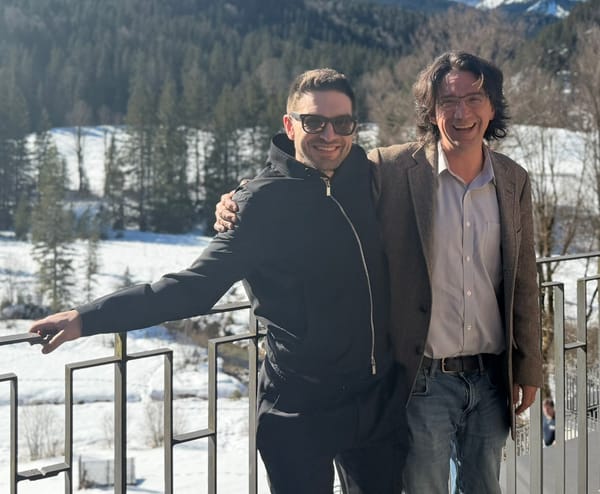
Kiera Butler: Well, and indeed there is a photo that was unearthed by Jenny Cohn, who's a great researcher of this kind of world, of some of the New Founding guys, the Theo Bro guys, with JD Vance. And it's not entirely clear where the photo was taken, but it's JD Vance with a bunch of those guys who are connected with New Founding, American Reformer, Claremont Institute, Rockbridge Network. So it's this very kind of upper echelon dynamic that's going on there, which, you know, I wanted to, you know, use that idea also to go back to a point that you were making before about, you know, the fact that folks who are living in this area of Appalachia might not want these guys to come in and take over their community.
There's also a class dynamic going on here because, you know, these are the Rockbridge Network. I mean, Chris Buskirk, like, these people are like the richest of the rich, 1% people. And, you know, one thing that they're trying to do, this community on Appalachia is make this like hunting lodge event space. Like, it's not entirely clear, you know, who this is for. Like, is this for their rich friends to like come and have hunting trips? Like, and how do the folks—and you know, they talk a lot about on their, in their promotional videos about like, just the simple country folk who live here and have these, you know, salt of the earth traditions, but that's not who these guys are. So there's this very strange kind of class dynamic that's happening there as well.
Gil Duran: No one wants to be sort of fetishized by wealthy people who wish to sort of suck out the essence of your being and market it as a lifestyle. You know, the people who hunt, they already know where to go in the woods and hunt. They probably don't want you in their spot, you know. But it seems like what they try to do is create spaces where they can create a community and further bring people into their ideology more than anything.
But in a way they're trying to create something that is not needed in communities that already have this. And I would say that what these communities do need is really not these folks bringing their ideology to town, but maybe bringing some investments in local businesses or housing or solving some of the poverty and healthcare needs that plague rural areas. But instead it's like, no, let's bring our cult of people and put up a weird hunting lodge where we're going to preach at you our version of Christianity. And I just don't see that really working, which is why I think a good point that Balaji makes is he favors exit, getting out of the United States, getting out of democratic society.
These efforts to sort of take over are often rejected. We see it everywhere. In Solano County where they're trying to build California Forever, which they say is not a Network State, but it's all Network State'd out. Esmeralda, which is clearly being proposed by someone who's immersed in Network State, but claimed it's not the Network State—there's already this rejection of this idea from people wherever they go. And so it'll be interesting to see what happens.
I do think though, that these Christian nationalists are having an easier time infiltrating politics than they are infiltrating the communities where they're trying to build their cult compounds. The United States is under attack by multiple extremist movements with similar anti-democratic ideals. While we see some of that expressed through the Trump administration, I don't feel like there's enough coverage on the fact that there's an organized, moneyed forces behind some of this stuff.
You're one of the few reporters who does cover extremism. I think we should be reading about extremism every day in the major newspapers. It's an important beat right now because if this stuff works out, it'll be the story of the end of the American democracy. And that'll be an important story for people to have told. What do you think people need to know that's most important about the areas you cover? And what do you wish the mainstream media were doing differently?
Kiera Butler: I want to go back to something that you said earlier about the similarities between techno-optimism and religion. I went to a Bitcoin conference a few months back. My idea was to frame Bitcoin as a religion, but the similarities between this Bitcoin conference and the revivals, the prayer rallies, the charismatic Christian church services that I've been to were astounding.
If more people would cover techno-optimism in the same way that they cover religion, I think it would help people to see the ways in which techno-optimism has become religion-like, but also the reasons that we're seeing so much convergence between the world of tech, of Silicon Valley, and the world of Christian fundamentalism.
Gil Duran: Well, Peter Thiel has famously written that you should run your startup like a cult. And his Antichrist speeches make it clear that he understands that religion, apocalyptic religion, is an important technology for politics. It really motivates people. You have to create a belief that makes people join you and give their all. And so I think that's part of what we're seeing with this.
I do think that, you know, I call it the tech religion. Others call it TESCREAL—transhumanism, extropianism, singulatarianism, cosmism, rationalism, effective altruism, longtermism. We've had an episode on that in the past. But if you look at what they're promising, right, it requires tremendous faith that if you're a believer, you will get to the promised land. You will get this big thing. You'll become a Bitcoin millionaire. Bitcoin Jesus will save you from the Antichrist fiat. It's increasingly promising eternal life. The idea that technology and AI will solve death.
You've got Brian Johnson out here tripping publicly on psychedelic mushrooms like a sorority girl at her first Burning Man trip and live streaming it. You've got heaven. We're going to go live in the stars. We're going to be multi-planetary, eternal heavenly beings. You've got the promised lands. You've got the Network States. We're going to go create tech Zionism. We're going to have our own promised land. We're the chosen ones, right? We're the good ones who are going to live and thrive after the apocalypse and everyone else is gone.
I could go on and on and actually I do in my forthcoming book, The Nerd Reich: Silicon Valley, Fascism and the War on Democracy. But it's amazing the degree to which actually they're creating a religion. And I think that's something that you're onto and that a lot of other folks are still trying to cover tech as if it's a business story. It has gone beyond business, right? There is an emerging cult and it's a religious cult in many ways. Thank you so much for the work you do and thanks for joining us here on The NerdReich Podcast.
Kiera Butler: Thank you so much for having me.
Producer: The NerdReich podcast is produced and edited by me, R.R. Robbins. It's written and hosted by Gil Duran. How about you take a minute and pre-order Gil's book and sign up for the newsletter. You can do both of those things at thenerdreich.com. Today's final words from author Tom Robbins: "A sense of humor is superior to any religion so far devised." See you next time.