You Don't Need Democracy If You Don't Have People

This Friday 12 p.m. Pacific (February 13), I'll host a live Zoom conversation with Jacob Silverman, author of Gilded Rage: Elon Musk and the Radicalization of Silicon Valley. Over 60 readers are planning to join so far. The link will go out Thursday. Questions for Jacob (or me)? Please leave them in the comments or email me at gil (at) thenerdreich.com so we can ask them during our Zoom.
Will tech billionaires get rid of democracy by getting rid of people?
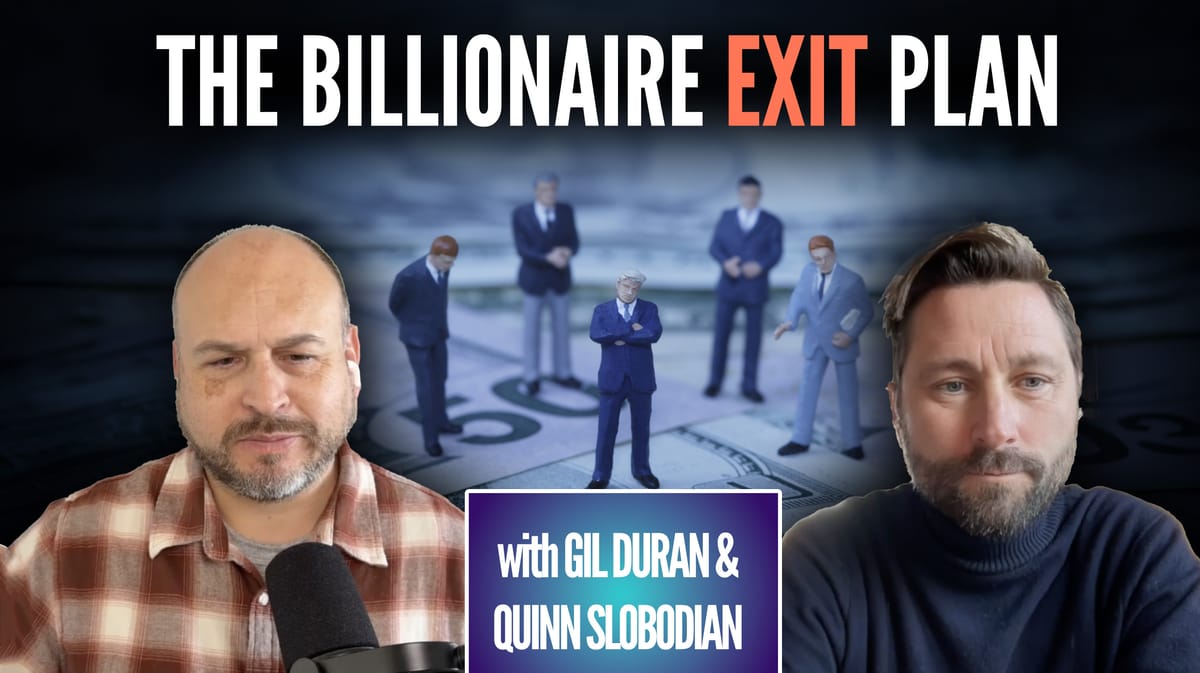
In this episode of The Nerd Reich podcast, I talk with renowned historian Quinn Slobodian, author of Globalists: The End of Empire and the Birth of Neoliberalism and Crack-Up Capitalism: Market Radicals and The Dream Of A World Without Democracy.
Slobodian’s work helped inspire my own, so it was great to interview him. His writing illuminates the extremist ideas underlying billionaire fantasies of “exit” from democracy.
In this episode, we explore:
- The Hong Kong Blueprint: How a colonial relic became the template for 21st-century capitalism.
- Authoritarian Capitalism: Why Silicon Valley elites are obsessed with models of control.
- The Post-Human Zone: Why the future of “sovereignty” might belong to Manhattan-sized data centers, not citizens.
The Octavia Butler Reality: What if future isn't about escaping the “company town,” but fighting to get into one?
Connect with Quinn Slobodian on BlueSky.
Click below to listen:
Full transcript below
The Billionaire Exit Plan w/ Quinn Slobodian
Transcripts are auto-generated and may contain errors.
Gil Duran: How did we get here? Jeff Bezos owning and destroying the Washington Post; Palmer Luckey calling for a tech city in Guantanamo; Joe Lonsdale dreaming of public executions.
How has so-called tech libertarianism curdled into open authoritarianism?
If you want to understand the dangerous ideas driving Silicon Valley's war on democracy, few people understand it better than Quinn Slobodian. Quinn is a historian at Boston University and his books expose how wealthy elites are working to create a world of capitalism without democracy. His work explains how billionaires are drawing up a road map to exit from democratic nations and create privatized sovereignties where the rich make the rules for everyone.
In today's episode, we talk about what's actually happening with all these network state and freedom city schemes—about whether tech billionaires will really be satisfied with fascist dystopias in Africa, in Greenland, and in the United States, or is their vision even darker? Data centers the size of Manhattan, dark factories, an infrastructure that doesn't need democracy because their future doesn't need people.
I'm Gil Duran, and this is the Nerd Reich podcast.
Gil Duran: Quinn Slobodian, thanks for joining me here on the Nerd Reich podcast.
Quinn Slobodian: Very happy to be here.
Gil Duran: I tell everybody who's curious about my work that they should really read yours, because your work played a big role in getting me to take a deeper look at these ideologies coming out of tech and Silicon Valley, these ideas of wealthy elites who want to exit from democracy and society. I was recently going through Crack-Up Capitalism again, and it was mind-blowing to me how much that you talk about in that book you can see all around us now happening. So while you're waiting for my book to come out, read Crack-Up Capitalism, because it very much is born out of the work Quinn Slobodian has been doing for a very long time.
Your work illuminates the ideology of exit, of wealthy people who wish to escape taxes, regulation, and society and live in their own worlds of privatized sovereignty. These are men who dream of capitalism without democracy. Your books expose the long history of using special zones, be they Hong Kong or the Cayman Islands or Dubai, where the usual laws and rules don't apply. And we're seeing that strategy today metastasize into something far more ambitious and dangerous than it has been in certain past iterations. How did you get interested in the subject of zones and the ideology of a world that foresees capitalism without democracy?
Quinn Slobodian: Crack-Up Capitalism, for me, was very much understood as a sequel to a book I'd written just before that called Globalists. My basic feeling as an intellectual historian, a historian of global history, was that we often failed when we tried to understand the world in the terms that were provided to us, understanding the world as comprised of billiard ball nations, a world as a set of containers, and we are citizens of one nation and not of another. And if we think about something grander than that, we might think about the United Nations or other forms of international law or international organizations. And then beyond that, there was this abstract world that got referred to as globalization.
And Globalists, the book I wrote before, was a way of talking about globalization not as a liberation of markets since the end of the Cold War, where everything was set free, and money and goods and people were able to zap around the world like lasers. But in fact, the '90s and 2000s as a time of an increasing encasement of the world's markets through new agreements, new laws, new regulations, which made certain kinds of economic futures possible and made other ones not possible. And that often, in the process, meant people and nations ceding certain parts of their sovereignty upward to multilateral organizations or international agreements, made things like free trade, capital security often have more priority than the rights of people inside nations themselves.
So this is often referred to as neoliberal globalism, and what I did with that book is I said, "This thing has a long history." Goes back to the end of the empires, of the Habsburg Empires and the Ottoman Empires at the end of the First World War, and it's actually been an eighty-year project to try to figure out how to build up a legal and institutional architecture that can sit on top of nations and provide exit possibilities for capital, can provide security for investors, and provide certain kinds of mobility and not others.
Crack-Up Capitalism came as a sequel because my feeling was that we were not entirely clued into things happening above the nation, but we were also perhaps even more ignorant about things happening beneath the envelope of the nation in the space of what I talk about in the book as the special economic zones, where since the 1970s especially, nations have ring-fenced jurisdictions inside of their nations and given them a separate legal status, separate regulatory status, often lighter labor laws, often lighter environmental laws, and done so to make them into bespoke landing pads for transnational capital. Lift the regulations here to make it more likely that an investor comes and builds a factory here. You lift certain kinds of oversight there so that people will use that as a place to book profits offshore. And this has become the functional fragmentation by which globalization works, even as it becomes more integrated at a supranational level.
So my first goal was really just a descriptive one, as a historian, as someone who teaches history in the classroom, to figure out ways to introduce readers to sets of geographies they might not always be that familiar with, the kinds of places that Geneva and the WTO create, and then the kinds of places that Hong Kong and Dubai create, and even smaller than that, economic zones that might exist around your local port authority or even some place no bigger than a warehouse off the side of a highway, but nonetheless offer a machinery for the everyday workings of globalization. So it all began as a pedagogical project in a way, or a project of political education.
But as you say, there is a payoff that aims more in the direction of techno-libertarianism and some of the more drastic fantasies of the recent Silicon Valley, right? Because not everyone just saw this as a project of building infrastructure of global investment and capitalism. Some people, the very people that we both study, took that as a way of imagining a world where the zone could become not just part of a landscape of globalization, but a prototype for reorganizing global civil society as such.
Gil Duran: Capitalism always has to innovate and accelerate and find new profit centers, so I see this metastasization as an example of that. It is now about getting beyond even not just little zones. I worked for a governor, I worked for a few mayors. We use zones to incentivize bringing a biotech office here or there, but it doesn't mean you get to escape all laws, all regulations, and you're no longer part of our democracy. So what they're doing is saying, "Hey, this can be used as an escape hatch from the entire system."
And in a way, what they're doing is trying to monetize the idea of sovereignty. We will create this new zone, be it a warehouse on the side of a highway or a piece of land in Latin America, and you can pay us to become subscribers of that zone, and we will offer you freedom from democracy and belonging in this other form of a nation. So on one level, they're trying to remake government in their own image. It's interesting how this comes out of anti-government ideology, and we'll get to that in a minute, but the use of zones to create special governance dates back a pretty long time. It's not exactly new. You use Hong Kong as an example—
Quinn Slobodian: Yeah.
Gil Duran: The City of London, the financial zone, not the actual city itself, for those who don't know—
Quinn Slobodian: Mm-hmm.
Gil Duran: It's a bit of a confusing term 'cause people are like, "What do you mean London?" No, the City of London is a very different, the Wall Street area of London. That's a zone. You use these examples as core ideas, but you've also documented how the zones work in Honduras, Dubai, China. There's a wide range of zones and what they're used for, so give us a brief history of zones, and what distinguishes a zone from a simple privatization or special economic area? What makes a zone a zone, really?
Quinn Slobodian: Yeah. That longer history of what a zone is and the prehistory of the modern special economic zone is one of the things that I've found most interesting about the topic. Because we take for granted now that if you imagine a map of the world or the globe, it's divided up into two hundred-some-odd units that are nations, that are somehow internally consistent. You imagine them being a relatively smooth legal space internally, inhabited mostly by citizens of that nation, that may be recent immigrants, but also may be people with a longer history of settlement or residence in that patch of territory, but that there's a legibility to the world. You will look at the map and see the familiar logos and the outlines of the borders of nations from Iran to Nigeria to wherever.
But that is actually a very recent version of the world map, right? If you look at the world map from the nineteenth century, you'll see a world in which large parts of the map are painted the color of the mother empire, usually pink for the British Empire. Parts of the map are still painted the color for the Portuguese Empire, the French Empire, and so on. And these are often large, sprawling territorial holdings that were, in fact, very loosely administered in many cases, so there wasn't necessarily a lot of on-the-ground presence. Often, it was indirect. It was being done through local elites. It was being done through local, more hereditary forms of leadership.
If you looked even closer, what you would find is actually a great variation in the political and legal arrangements that characterize the world of empires. My book does indeed begin with Hong Kong for a reason, because when Hong Kong was granted under duress by China to the British, it was granted as a special kind of space—it was a Crown colony, but it was designed to act as a free port, so they could allow for trade from neighboring merchants, even from people from neighboring empires that could operate duty-free. Singapore was designed similarly in the nineteenth century, basically settled by an emissary of the British East India Company, turned into a self-managed space through arrangements with local elites, sometimes through military domination, and then opening its doors to local merchants, and thus winning a kind of momentum, and in a certain way, a kind of consent from a local commercial class who was able to take advantage of the access to global markets that they could use through this gateway to global consumers.
The world of empires was filled with these concessions, hinterlands, treaty ports, extraterritorial enclaves that were settled by different European powers. So there was a real patchwork mosaic of politics and of laws that characterized the world of the nineteenth century. If you look at the politics of reactionaries, whether they're capitalist reactionaries or more cultural reactionaries, often they're actually quite annoyed by the era of the modern nation-state. We think of the right as being nationalist, but in fact, nationalism was a mixed bag if you're a conservative or a reactionary, right? Nationalism, yes, it brought new regimes of exclusion and new forms of military expansion, but it also brought the possibility for redistribution, welfare, rights being shared across a national population. Ultimately, democracy comes out as a practice, as a conjoined twin in certain ways of the nation.
People on the right have often dreamed about somehow rolling back this process of the emergence of a pretty stable map of two hundred nations and trying to figure out how to perforate holes again in that map, and design spaces now that they could use for their own purposes, that would be designed according to their own desires, and that would, most importantly, get around that problem of popular sovereignty and the dreams that often accompanied the end of empire in the nineteen sixties and seventies, the high point of decolonization. The writings and work of people like Frantz Fanon and Kwame Nkrumah, Che Guevara, these people are all speaking at a time when the nation was actually something that was seen as the endpoint of a very vigorous liberation struggle.
It was precisely at that point, not coincidentally, that Milton Friedman and other free market radical intellectuals rediscovered a place like Hong Kong and fell in love with it, because it was a place that had been insulated against those demands of post-colonial sovereignty, had remained a colony. It had been insulated against the demands of democratic accountability. It was governed more or less like a corporation. The financial secretary was more important than the governor. Both were appointed directly from Westminster. It was a place that mostly saw the business of governance as about creating a stable and inviting investment climate for people who wanted to, by the nineteen sixties and seventies, do textile manufacturing, do plastic flower and souvenir manufacturing, and do the beginnings of financial services, especially as telecommunications made the possibility of a global workday for the financial world a reality.
The storyline of my book is the emergence of the post-colonial nation, and then the short-circuiting by way of something like Hong Kong back to an imperial age of the nineteenth century, and then the attempt to make now this very old-fashioned thing—what's more old-fashioned than a crown colony of Hong Kong?—how can you make that look futuristic? Make this relic appear like a template for late twentieth century and eventually twenty-first century capitalism.
And the zone that they then begin to design becomes distinctive in the sense that it is subnational, it is territorially defined, and it is characterized by a different set of laws and regulation than those that exist outside of it. Those regulations include a certain insulation from democratic accountability, right? So that's why it's different from, let's say, the famous example of a suburb of Atlanta seceding when richer parts of sprawling cities decide they don't want to pay taxes for the inner city, they'll secede. They haven't created a zone exactly, because they are still operating at some level with an idea of a democratically arranged political space. They've reengineered it in a way that is better for their own perpetuation of their own wealth. But a special economic zone becomes that by the fact that it suspends normal forms of democratic practice and governance.
So for those people who are hearing about this for the first time or have not thought about it for a while, it's important to know the basic narrative is that even if Milton Friedman and a couple of his neoliberal buddies saw and fell in love with the zone model in Hong Kong in the late 1970s, and indeed then brought it back to Thatcher's England, people might know Canary Wharf, the second financial center now alongside the old City of London, the Square Mile. That was a direct attempt to export a Hong Kong model by taking power out of the hands of a local left-wing labor council, giving it to business people, giving them a huge number of pieces of corporate welfare and transfer of public funds, allowing for a new space that is not responsive necessarily to the needs of the community, but is very responsive to the needs of the financial sector.
But where the thing really kicked off, besides these one-off examples, they tried to do it in New York, too, didn't get very far, but it really took off in mainland China. When Deng Xiaoping did his reform and opening-up period beginning in the late 1970s, the way that China opened up is through the zone model. So China did not open up all at once. It did not do a perestroika, it did not do a glasnost. It did zonification. So Shenzhen, right next to Hong Kong, was the first example, literally ring-fenced off. When you entered, laws changed. You lost access to the social welfare you would have had back home. You lost access to the lifetime employment contract you had back home. What you gained was entry into a place where there was now wage labor for foreigners to invest, the ability to own land, and for some people, the ability to get very, very rich.
This model was replicated up and down the coast of China and eventually in most parts of China. So most of the special economic zones that we have now in the world, of which there are over six thousand, most of them are in China. And that is indeed one of the reasons for focusing on them for me, too, because I feel like even now, when the power and might of Chinese political economy is so obvious, we still don't have very many good narratives for understanding how that happened. We don't actually have a smooth story that we tell, let's say, to high school or college students about how the Cold War period entered the globalization period, and then suddenly, here comes China as a peer of Americas.
I think the zone is a secret way into that story because you can show how through trial and error, gradualism, reformism that was more experimental than it was absolute, China was able to introduce commodification, privatization in these patches of land in such a way that they were able to work with their advantage in the global international division of labor and fine-tune it really in a way to fit demands of the world market.
Gil Duran: So they were able to do a reverse Hong Kong in terms of little patches of capitalism for laboratories of experimentation without the risk of interference or infection by American ideas and its government. And it seems to me that in a way, what some of these new network state types or zone promoters are after is sort of a reverse of that, which is how do you carve out zones from democracy where we can experiment with corporate capitalist authoritarianism?
In a way, what I see a lot of is these guys basically saying, people like Peter Thiel, Balaji Srinivasan, who's the main force behind the network state movement, saying essentially, China got it right. It's about authoritarian capitalism is the twenty-first century, not this thing where we let people vote and have opinions. And so in a way, it's important for people to understand that history in China because it shows you the power of what a zone can do. In this case, it's interesting that a communist country is at the heart of global capitalism today, right? Everybody needs China for manufacturing, for technology, for all of these things. And so they've been able to create this hybrid system that gives them capitalism without democracy, which seems to be the exact same thing that our Silicon Valley would-be overlords are after.
Quinn Slobodian: I think that's a really good way of putting it. And one can see this very clearly in the things that they say and as I reproduce in the book. I mean, the book is a work of history. It's mostly driven by archival sources, so it's not so much me just saying, "Here's my idea of what's happening." It's me recounting articles people published, conversations they had over the last fifty years to show the development of a counterintuitive line of thinking, which nevertheless is exactly what you're saying, which is: how can it be that self-described libertarians, self-described believers in freedom, could become so fixated on something that is quite clearly an effort to realize authoritarian capitalism, a capitalism without democracy?
Time and again, they make that so clear in the work they were doing, for example, in the creation of what I describe in the first chapter of my book, an index of economic freedom, which is specifically designed against indexes of freedom like that of Freedom House, which is very well known, which is focused on things like multi-party elections, the freedom of the press, the freedom to congregate, the freedom to protest. The people I describe in the book quite literally saw that and said, "That's not freedom. That isn't freedom. Being able to vote isn't freedom." Why? Because democracies lead to people demanding more and more from the government. It leads to higher taxes, and taxes are nothing more, as they said, while they're designing this index of economic freedom, than forced labor requirements.
For me, as a historian, my way of going about it is give people the rope to hang themselves with, right? I don't actually need to go out and condemn them because of my own moral outrage. I think we can actually just draw their arguments as they exist. And what you see then is a kind of openness to global events in a way. That's one of the things that I think what you're describing is helpful because they were more sensitized to what was happening in China than many other people were. So the mainline political liberals weren't that interested because they just saw lack of democracy, they saw oppression, the use of cheap wage labor, and people coming in from the countryside, not being given social rights, just being thrown into the grinder of sweatshops.
But the libertarian and neoliberals in the US and the UK saw these zones, and they called them, in this extraordinary example that I have from the early 2000s, "the Hayekian islands of experimentation." To them, China was the one that was pushing Hayek's idea of evolutionary discovery of new forms of institutions that were better adapted to market competition because they were freed from the veto points of democracy, right? So that very person compared China unfavorably to the European Union. So this person was a conservative in the UK who wanted to leave the European Union. He said, "What do we have in Europe? We have this sclerotic mass of regulations that we got to by an overdose and aggregation over time of too much democracy."
Whereas what do they have in China? They're wise enough to sweep away the democratic veto point and let entrepreneurs make their own choices inside of these zones. And when they go too far, when they get too big for their britches, when they start challenging central power, you cut the cord. You close down the zone that they're working on. You do what they did with Jack Ma, right? You compel them to sell off parts of their portfolio, send the signal down the party chain that they are no longer to be given favorable treatment. Indeed, a masterful oscillation between central power and decentralized power, where you let things happen at the periphery, guide them from afar, soft credit, whatever, special treatment, but then if the problems happen, you seize them and choke it out, the same way you would with any franchisee or whatever.
Patri Friedman, who you talk about, were watching this stuff. They were watching the example of Hong Kong and the example of the Chinese special economic zone and were filled with admiration. So it's a hundred percent certain that the things we think of now as exit models of right-wing libertarianism are based explicitly on East Asian models. So it's not for nothing that Srinivasan is, at least for a while, was based in Singapore and has set up his network school in Malaysia. The kind of stuff that, for example, the Berkeley anthropologist, Aihwa Ong, has described as the graduated sovereignty that exists by virtue of this zonification is a laboratory for the alternative forms of governance that someone like Friedman is interested in, right? The supposed Cambrian explosion of government forms is something that East Asia actually has been doing for the last fifty years, right?
Gil Duran: We often hear, in California, people criticizing the state, for instance, the slow progress of high-speed rail, saying China would have this done in two years. But it's a lot easier when you can just bulldoze the people off the land, and no one has any rights to stop you. You know, it's much harder in a state where there's laws, there's rules, there's property ownership. They often leave out the important parts of what makes China's rapid movement on certain kinds of things possible.
But now, our plugs.
[MID-ROLL AD BREAK]
Riley Robbins: And that's halftime for the pod, which means it's time for the plugs. Quinn Slobodian, the most name-checked expert on the Nerd Reich pod across all of our guests. He has a number of great books you should check out today, and some of which we've talked about already. Globalists: The End of Empire and the Birth of Neoliberalism, Crack-Up Capitalism: Market Radicals and the Dream of a World Without Democracy, and Hayek's Bastards: The Neoliberal Roots of the Populist Right. His new book is with Ben Tarnoff. It's called Muskism: A Guide for the Perplexed, releasing April twenty-first, so pre-order it today. And speaking of pre-orders, also pre-order Gil's book, The Nerd Reich: Silicon Valley Fascism and the War on Democracy from Gil Duran. Releases this August, but it makes a great Christmas gift. Never too early. Now, back to the pod with Quinn and Gil.
[END AD BREAK]
Gil Duran: And we're back. You mentioned Hayek, and you wrote a book, Hayek's Bastards, which really looks into the history of the ideology that has led to some of these ideas, zones or libertarianism, which has now morphed into something else, especially in the era of Donald Trump. And Hayek genuinely feared that government, big government, would become totalitarian at some point. And for a long time, I feel like there was this idea that there was something called libertarianism, and that it was somehow about protecting individual liberty and blocking government authoritarianism.
And a lot of people in Silicon Valley adopted the libertarian moniker, people like Peter Thiel, for instance, that that was their politics, not right or left, but libertarian, although one might argue that libertarianism is inherently right-wing in certain very important respects. But along the way, it seems like this idea has curdled into something else, and that the fear of totalitarianism or serfdom has become active hostility toward democracy and a road, a literal road to serfdom, at least for the majority of people in the world who are not wealthy enough to have ownership in some kind of zone that is free of democracy. Give us a little bit about who Hayek was, what his main ideas were, and how they have been used more recently to promote a very right-wing ideology of exit.
Quinn Slobodian: Friedrich Hayek was born at the turn of the century in Austro-Hungarian Empire, was raised and socialized as a member of the Habsburg Empire, and would have rightly assumed that he would've taken a role at some point as a civil servant, as an overseer of the Austrian Empire, operating from Vienna, as most people of liberal education would have ended up. The war intervened, and the Habsburg Empire collapsed, and Austria was shrunk to this little miniature version of itself. Due to his brilliance, he was plucked out of this relative obscurity and brought to the very heart of academic prestige at that time in the 1930s, which was London School of Economics, where he ended up crossing swords with John Maynard Keynes. He was brought to LSE by Lionel Robbins, and he became someone who represented the more skeptical wing of the liberal economic establishment in the sense that he feared the openness of the Labour Party and the openness of British trade unions to more collectivist forms of politics that were being, at that time, still spoken of quite highly in the Soviet Union.
So the 1930s, it's important to remember, was a time when many people were in awe of the Soviet industrial expansion and growth, and it was not quite yet taboo, actually, for people even in the center left to speak highly of the Soviet Union. And Hayek was very concerned about that from the beginning, set himself up as the, in some ways, loyal opposition, though not always that loyal, to what became known as Keynesianism. So as the welfare state came into existence in the course of the Second World War, he became the skeptical voice on that.
And I'm not phrasing this in as dark a way as it's sometimes phrased, because if you read his most famous book, The Road to Serfdom, from 1944, you might be surprised, as sometimes my students are, to find that there's quite a bit of what we would call the welfare state is in that book. And he actually does believe there needs to be some kind of floor set for the very poor. He does believe that there can be some kind of taxation if it's being used for socially positive purposes. So it's not a radically libertarian text in the way that we now think of radical libertarianism.
And that becomes important because as he becomes more famous in the 1950s and '60s, and especially draws disciples in the United States, you get a fight over the meaning of Hayek. So he himself lives until his 80s, so he doesn't die until the early 1990s, and on the one hand, he becomes a mascot for people like Margaret Thatcher and Ronald Reagan in their campaigns for austerity and welfare reform. But then he also becomes a fought-over figure within the intellectual worlds of the neoliberal and libertarian community, some of who are interested in his ideas of social evolution, as I alluded to earlier, this idea that we should think about the world as filled with peoples and communities that are constantly in a process of Lamarckian evolution, and when some communities figure out habits that make them plug better into the world free market, then those habits proliferate and reproduce and become more dominant.
Habits and mentalities he did see as connected to racial groups and national groups, but it wasn't a hard line. He thought there could be emulation, populations could learn over time, and he didn't have extremely reactionary views, in fact, on things like race science. Some of his people in his extended circle, however, did. What I describe as Hayek's bastards in that book are the people who are in the larger orbit of Hayek, who, in the 1980s and '90s, and into the 2000s, took his ideas of communities that were evolutionarily competing and really bolted it on to very old-fashioned ideas of hyper-exclusionary race science.
So someone who is probably the most famous figure there is Charles Murray. In his 1994 book, The Bell Curve, he brought out of the cupboard all of these dusty old ideas of IQ and intelligence measurement and tried to put together an idea of libertarianism in terms of economic capacity with an idea of race science and used that as a new way to justify things like immigration restriction, pronatalism for high IQ—the right racial groups—and opposition to what he calls the dysgenic tendencies being produced by the welfare state.
So what people would know now as the alt-right or the more recent far right is a sometimes uncomfortable, but by now certainly consistent, melding of ideas of economic freedom with ideas of racial essentialism and national essentialism. Where I think we're at now, and this is what I think is actually quite interesting, is a rupture within the libertarian and broadly speaking, Hayekian community. 2020, I think it was, Tyler Cowen, who is an important neoliberal thinker, made a passing remark in his blog, Marginal Revolution, which I think is actually quite important, where he says, "The libertarian movement has split."
What was the split? He said, on the one side, there were people, and he was claiming it was people like him, who were interested in what you call state capacity libertarianism. So how can you get a productive relationship between governments and private enterprise, that government acts in a way that is not wasteful or driven only by the demands of marginalized groups, but is operating in a way to keep the flywheel of economic growth spinning and even innovation spinning and when necessary, going over the heads of the democratic populace. So your point just now about high-speed rail in California is exactly to this point, right?
The two biggest books in the ideas policy space from last year were Dan Wang's book, Breakneck, and Ezra Klein and Derek Thompson's book, Abundance. And both of those make the very point you're making, which is that China was able to do what it has done because it did not get bound up in laws and regulations, and it organized the state the way engineers organize states. It sees a big problem, solves it without being too concerned with consulting every single person along the way.
According to the Tyler Cowen model, that is still in the tradition of Hayek, and I don't think that's totally wrong. It's not for nothing that someone like Matt Yglesias and Conor Friedersdorf, who are in the Abundance orbit, were just this last week speaking about The Constitution of Liberty by Hayek as this extraordinary book.
But there's another side of the Hayekian lineage that Cowen also referred to, within that George Mason University world, often referred to as the fever swamp libertarians. And it's associated with one particular place, which is the Ludwig von Mises Institute in Auburn, Alabama, which was set up in 1982 by someone named Lew Rockwell, and from the beginning, was designed to be the culturally conservative, more right-wing version of Hayekian or libertarian thinking. So to them, the Cato Institute, The Heritage Foundation, had gotten too close to Washington, DC and had just become a policy shop and had given up on their libertarian bona fides.
So you needed to get back to the root of hardwired culture, hardwired belief in religious values as well, and a kind of open willingness to pay fealty to things like racial difference, national patriotism, in a strong opposition to neoconservative foreign policy abroad. So the other reason they'd be against The Heritage Foundation is they think they've tied themselves up too much with the military industrial complex and the willingness to send American troops overseas to do things like promote democracy.
You have the DC Beltway libertarians who are trying to make peace with the state insofar as it can realize their interests, and then you have this much more volatile wing of right wing with a lot of crossover with the very online alt-right world that we now talk of as gropers. So the Libertarian Party itself, for example, has now been taken over by the Mises Caucus, which is awash in memes, very interested in a kind of violent nativism, gleefully embracing misogyny and white supremacy.
I think that the way that libertarianism and Hayekianism circulates on the right now and in the present MAGA moment is an interesting mixture of these two sides. I think there are still people who believe in a kind of praiseworthy industrial policy of some kind, a more business-friendly, as you well know, Silicon Valley-friendly understanding of what the state can do to pave the way for the frontier investments in AI in particular that need to be done. And they think they can do that while still holding on to their libertarianism. It's a Chinese model of authoritarian capitalism that somehow, not giving in to the real problems of the modern pathologies of the state, which is democracy. And then it's no secret that there's also the darker groper wing of the libertarian community now, which is primarily interested, it seems, in cultural issues, if not outright demographic issues.
Gil Duran: Which seems to be largely winning in many ways because they can be so much louder than the people trying to find some kind of nuance in those ideas. You know, you mentioned Charles Murray, and I wanted to bring this up, although we could do a whole episode on this particular topic. The Sovereign Individual is a book that really wrapped up some of these ideas into a more modern package back in 1997, and that book by James Dale Davidson and William Rees-Mogg predicted a future in which technology would collapse existing nation states and lead to chaos and crime because automation was gonna fundamentally change everything, but that cognitive elites could escape into more protected private zones of sovereignty and be the builders and the masters of the future in this way.
And the first time I read that book, I didn't fully understand the degree to which "cognitive elites" comes straight out of Charles Murray and The Bell Curve, the idea that some people are better and smarter than other people, and therefore should rule, which is a very old idea we can trace all the way back to the Greeks. But in a way, it's inescapable that an ideology that is founded in this idea of certain elites deserving a higher place in a hierarchy over others would eventually become infected by all of the other supremacies and hierarchies that exist in the political world.
So we're seeing that, I think, in real time happening, and so much of what the zone idea is becoming is a form of new colonialism, colonialism with a tech twist. When we look at building a city in Honduras, Prospera, or taking over Greenland, which is mostly an indigenous population, and maybe building a freedom city there. Within a week of Maduro being kidnapped by US forces, the head of the Charter Cities Institute was pitching a freedom city in Venezuela. So in a way, it seems inescapable that these things would slide toward hierarchy and supremacy.
Curtis Yarvin gave an interview to the Anglo-Futurist podcast, where he said that what the UK needs to do is re-embrace its eighteenth and nineteenth century colonialism, and it needs to recolonize Africa, and envisioned a year 2100 Africa, where every person is under surveillance like cattle in Wyoming. He literally made that comparison. And we know where all of them are, and we give them kind of a subsistence living, but we don't allow them to breed too much. So when you have people out there who have been funded by billionaire capitalists pushing the hardest line possible, it's hard for the more mumbly version of that to compete.
Quinn Slobodian: I definitely hear what you're saying. I think that it's not for nothing, and this is the example I bring up in my book, The Sovereign Individual is, in a way, speculative science fiction, right? I mean, it is both a description of the way that globalization was going by the late 1990s as they saw it. You had increasing internet connections, the possibility of e-money or digital cash, allegedly part of the inspiration for Thiel to found PayPal. And they then project that forward and say, "Okay, what does that mean?"
Well, they say that means that existing nation-states are not long for this world, the labor of the masses is automated away, and welfare states collapse under their own indebtedness. A generalized system of civil war will set in, and we, the sovereign individuals, will exit and escape everyday territorial arrangements to live hopping from node to node, insulated from the dangers of a falling world. Neal Stephenson's Snow Crash is telling almost the exact same story at almost the exact same time, right, a couple of years earlier.
Fredric Jameson said that science fiction is always diagnostic, and so they're certainly diagnostic, right? They tell us something about the world in which they were written. The question, though, for me, is always: what political prescriptions might emerge from such diagnoses? I agree with you that these are, at least morally objectionable defenses of certain kinds of hardwired hierarchies, right? If I didn't believe that, I wouldn't have spent so much time writing that book.
Unfortunately, it's actually quite possible to live out all of the consequences of that kind of a belief system and be validated in them in our own current existing national arrangement. Right? So you don't actually need to create a new polity to have your own sense of entitlement and privilege reinforced in every imaginable way, and to have your own economic comfort facilitated by the institutional arrangements of the state in almost every way. With some creative accounting and some use of offshore havens and trusts and so on, you can really game the whole thing very well already, right?
So that leaves me with the question of: why would one go that extra level of effort to create a, let's say, a freedom city in Greenland or to recolonize Africa? Curtis Yarvin is a Swiftian satirist, basically, that has been taken seriously by gullible politicians, I would say. I don't know what's in his heart. I suspect I wouldn't want to know, but I think one can also see when he says things like that as being not the utterances of an evil man, although they might be that too, but also as diagnostic in the same way that Snow Crash and The Sovereign Individual were, right?
So when he was talking about turning Dubai into a corporation in 2009, that was the same time that Paul Romer, later Nobel Prize-winning economist, was saying similar things, right? Saying that Guantanamo Bay should be turned into a Canadian overseas protectorate and be turned into a new Hong Kong-style corporate entity. What he's saying now about Africa sounds a lot like Worldcoin, right? I mean, that's basically what Altman was trying to roll out by going out and doing iris scans of large swaths of any global south population he could get his hands on. That would be implicitly, right, a form of surveillance and biometric data mining.
So my question with all of these things is not has someone thought them or has someone said them, because the answer is, for almost everything, yes, someone has. Why would they be profitable or likely, given current situation? So Mark Lutter, Charter Cities Institute, product of George Mason University, has been on this beat for, as you know, decades, right? A very long time, and hasn't gotten very far. I mean, in some ways, I find what's interesting about the startup city movement is not that it exists or that it wants to do things, but that it's been able to do so little. Right? I mean, it's actually extraordinary that they have to make such a big deal out of Prospera, which is not that successful.
Gil Duran: It's like a hotel and a golf course and a few dead-looking offices.
Quinn Slobodian: Right. That's what I'm saying. That's what I say. People are not rushing there. If you sign up for their mailing list, which I do, just for research purposes, they're constantly just begging people to come and hang out because nobody wants to.
Gil Duran: Shittiest luxury resort in the world. That's what I heard.
Quinn Slobodian: Right, exactly. So that's the way it looks from all impressions. So I think there's two ways of interpreting that. One is our existing model of statecraft and the nation state as template is surprisingly resilient and resistant, actually, to venture innovative transformation, and that could be both good and bad, depending on how you feel about the nation. Or the other way of looking at it is they are harbingers of a larger shift, which we are only at the beginning of, right? And that they may look like failures now, but so did the beginnings of plantation agriculture in Ireland before it found the right conditions in the Caribbean or whatever. That these are actually the first shoots of something that may become a more dominant political model.
That's really the only reason to be interested in it, actually, is if you think it's the latter. What I find interesting about the present moment, and this is the arc of since we've been talking the last year and a half or so, is the breakthrough of this as a harbinger. The idea of it as a harbinger is now becoming something that media outlets seem to be interested in and clued into. So Spiegel, Newsweek, you're getting mainstream coverage of this idea of the freedom city and the network state. Yeah, I mean, in ways that wouldn't have existed before.
Now, I'm interested in the meta question, why are they interested now? And I actually have a theory about that, which is in the first Trump administration, the main narrative we had was globalization is over, nationalism is back. Nations competing with one another. There was the Russiagate idea, so this real concern about Russian interference in American democracy. But there was, in general, the political horizon was basically not more complex than thinking about nations or globalization.
In the intervening years, in the last five years, six years now, we have, I feel like, become more dipped in the acid bath of really online politics so that nothing really feels as naturalized anymore. The experience of the pandemic, the emergence of deeper and deeper silos that people live inside of online, I think makes the nation even seem tenuous now. And so the idea of the dissolution of that gap between the online experience of having your digital community and then an externalized real-life version of it, in the way that Srinivasan has been talking about for years and years, seemed pretty far out, I think, when he was publishing that some five, six years ago for the first time, but now I think it just feels intuitively more plausible for people. And so they're able to be like: "Oh, wait, is that one outcome of the present moment?" So it becomes more concerning.
Gil Duran: Until you go to one of their parties and realize there's no women there and everybody sucks. And then it's like: "Wait, I just wanna go to a bar in Oakland where there's real people and the possibility of a spontaneous interaction with somebody who doesn't work at the same company that I do." There's a lot of stuff, as you said, that they haven't thought through, and there's a lot of failure. For instance, Praxis, funded by Peter Thiel, Sam Altman, and Marc Andreessen, to create a new tech utopia city, first somewhere in the Mediterranean, then in Greenland, then in the Dominican Republic. I don't know. They keep changing the location. Last I heard, they were talking about building it in outer space.
Quinn Slobodian: Yeah.
Gil Duran: But it seems to have pretty much flamed out, and I think it flamed out because they gave a twenty-eight-year-old college dropout millions of dollars to go find a place to build a city, and I think he didn't do any of that, and he has now lost his funders, as far as I can tell. The media is now becoming aware of this Praxis idea at a moment when Praxis is kind of a zombie that no longer really exists. So everywhere you look, there's failure.
At the same time, this is their big chance. They'll never have a better chance than right now to get some of these zones carved out than under Trump, who has adopted a multipolarity strategy, trying to make the United States a colonial force, threatening Denmark to take Greenland, a NATO ally, which is insane and absurd. And he's also promised to build ten new freedom cities on federal land in the United States. And his son-in-law, Jared Kushner, is pushing the creation of a freedom city, a pretty serious proposal in the ruins of Gaza.
As I mentioned earlier, less than a week after the kidnapping of Nicolás Maduro from Venezuela, you have Mark Lutter of the Charter Cities Institute proposing a city there, which was really just kind of a pitch, right? But they sense that there's a possibility that Trump, a real estate goon, will understand the value of selling off some territory and creating these new zones. I'm not sure whether he'll really do it. Part of the saving grace of Trump is that he burns and rips off almost everybody he comes across at some point. And it seems like there hasn't been enough progress made so far to actually start getting these cities built, because an executive order would be the cleanest way to do it, so why hasn't he done it yet?
At the same time, you've seen people like Brian Armstrong of Coinbase and Palmer Luckey of Anduril a few months ago, were pitching online for Trump to build a freedom city in Guantanamo. So you've got billionaires pushing this idea, and you've got lobbyists right now working Capitol Hill to try to build support for the freedom cities on federal land. So in a way, it's Trump plus the Silicon Valley network state types who have been able to at least give this its day in court. And I think we're gonna find out in the next year or two whether the freedom cities thing is something Trump plans to pursue, or whether it was just something he stuck in his platform to shut up the billionaires and get their campaign checks. But I think this is really the make or break moment for them, at least for now. They'll come back again in the future when things are worse. But isn't it the freedom cities thing? They've kind of hyperstitioned this into the discourse.
Quinn Slobodian: Praxis has been good at posting, right? They're good at making memes, and that has gotten them a certain distance, but it probably won't breach the kind of materialist obstacles which I think still exist to something like this actually taking place. Because I think it's a question of cities for what? I mean, David Harvey has an idea of the spatial fix. The spatial fix is a solution to a particular kind of a problem, and it's not clear to me that the California Forever model, for example, is able to overcome the existing series of trenches of already existing municipal control that will make something like that possible.
And even then, what would it be a fix to, the problem of having a gated community or a suburb? I mean, that's not a problem. They actually already exist. You can make one, probably very easy. Someone would be happy to help you design one. Prospera is another example. Well, it's a spatial fix in search of a problem. It doesn't actually know what it's there for, because most of the things that they're trying to emulate are already in existence. If you're trying to emulate a way to have offshore registration of e-commerce, it's all over the place. There's lots of it. If you want a place to register a business in ways that will free you from accountability or to register a ship in ways that will lift a lot of the regulations, dude, that's how the world already works.
The reason why no one is flocking to Prospera is because we already have a globe filled of Prosperas, right? We already have thousands and thousands of examples of capitalism without democracy an actual existing business person could choose from. They've got a whole menu. I would say we actually do have the things that we're asking about. They're called Manhattan-sized data centers. They are the transformation of the American landscape, the annexing of LNG-burning power plants that's happened in the last two years, something much more significant than anything Prospera or California Forever was ever gonna be, that is happening right now. That's happening in Arizona, it's happening in New Mexico, it's happening in Tennessee.
So they are not inhabited by very many people, because they don't require a lot of people to operate. But I think something that is perhaps anachronistic about the freedom city is it's an understanding of an economic model of accumulation that perhaps no longer applies, right? I think that the frontier way of making money under digital capitalism doesn't require a city full of people. It actually requires a couple of engineers to run a mostly automated, enormous data center and in the future, dark factories that are being imagined by people like Bezos and Musk.
If anything, I think that the part that's not futuristic enough, in a way, about our expectations for the next wave of exitarianism or cyber libertarianism is us still having the naive belief that these things will actually be designed for humans. Most likely they won't be, and that's actually the scariest part about them, because once you've eliminated humans, then you've really eliminated the problem of democracy altogether. At the moment, that seems to be where it's at now, and the fact that Musk is in the process of, it looks like, merging SpaceX with xAI on the promise of data centers in space, these are the spatial fixes I think that we need to be worried about.
In the sovereign individual model, we are the hinterland, right? I mean, we are the ones left behind. The thing that I end the Crack-Up Capitalism book with is from a book that I'm sure that you love as well, Octavia Butler's Parable of the Sower. She has this great moment where her family is trying to figure out if they want to try to gain entry into this small settlement that's on the coast of California, that's a desalination plant that's run by a Japanese, German, Swiss, Canadian conglomerate or something. So it's this extraterritorial enclave. If you go in, you have to work like a dog in their desalination plant, but they give you housing and they give you security.
And her family is like: "Well, we live out here in the wastelands. We have precarious existence. There's marauding criminals everywhere, but we have a bit of our own autonomy. Do we wanna give it up to go into this thing?" The line that I think is so perfect from the protagonist is: "Yeah, I've read a lot of these sci-fi novels. They're always about these people trying to escape the company state or the company city, but real life is not like that. In real life, we're trying to get in. We wanna get into the company city. We wanna get into the company town, 'cause that's where there's a modicum of security and the survival infrastructure that you actually need."
I feel like that's still the turn that sometimes I'm worried our debates and discussions about the exitarians hasn't made, that actually we need to be bearing in mind that Octavia Butler's future is probably the right one, that most people are gonna be giving up as many of their freedoms as they need to, to get into these cities, rather than those things just vanishing into another planet or into an O'Neill cylinder, like in Elysium or whatever.
Gil Duran: Well, on that happy note, Quinn Slobodian, thanks for joining us on the Nerd Reich Podcast.
Quinn Slobodian: It was a pleasure.