Communion: How JD Vance Became an Epstein Class Errand Boy
The vice president serves two men with deep ties to Jeffrey Epstein
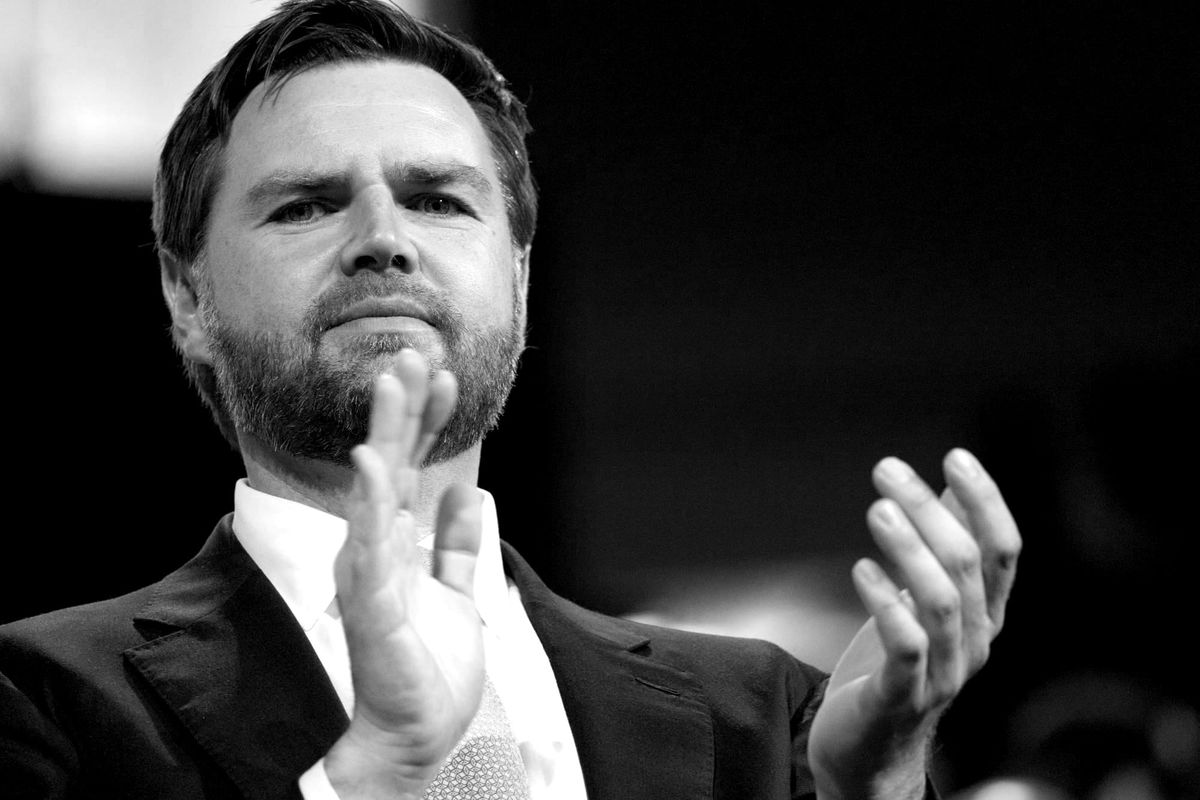
JD Vance said something bizarre the other day. During an appearance on The View, the vice president expressed concern about dead pedophile Jeffrey Epstein’s close ties with wealthy elites.
“I think that it’s crazy that you had this guy who is clearly a sex predator who was hanging out with a lot of very wealthy and powerful people,” said Vance. “Like, that really bothered me. I don’t know what’s there, of course, nobody knows exactly what happened unless you were there, but that really bothered me, and I wanted to have full transparency.”
Vance wants to be seen as a crusader against Epstein and his friends, but there’s a problem with this narrative. The vice president serves two men with incredibly deep ties to Epstein: Donald Trump and Peter Thiel.
Trump was one of Epstein’s closest friends and described him as a “terrific guy.”
“He’s a lot of fun to be with,” said Trump of Epstein in 2002. “It is even said that he likes beautiful women as much as I do, and many of them are on the younger side.”
Trump has since become a critic of Epstein, calling him a “creep,” but has continued to block the full release of the Epstein files—files in which, by one New York Times analysis, his name appears thousands of times.
Vance, who once described Trump as “America’s Hitler,” now serves under him. So, it is rich to watch him decry Epstein’s elite friends while playing the role of attack dog for Epstein’s former #1 bestie.
And it gets worse. Vance is largely the creation of one man, tech billionaire Peter Thiel. At every step of Vance’s career, Thiel funded him and promoted him. Thiel—Vance’s benefactor and creator—also had deep ties to Epstein.
Last year, the New York Times reported that Epstein had invested $40 million in a fund co-founded by Thiel. That investment has now ballooned to $170 million. Emails in the Epstein files show that the two men corresponded and met.
Trump and Thiel, the two powerful men on whom Vance’s future depends, were top Epstein friends and confidants. When Vance expresses his horror about Epstein’s seduction of wealthy elites, he’s talking about the two most important men in his life. Vance is a condiment in the Trump/Thiel/Epstein sandwich.
Vance was on The View to push his new book, Communion: Finding My Way Back to Faith, a memoir centered on his conversion to Catholicism. The book was supposed to have been published years ago as A Relevant Faith: Searching for a Meaningful American Christianity. According to Variety, Vance scored an $8 million deal for the book. But in 2022, Vance and HarperCollins mutually agreed to shelve the project. Now the same publisher has revived it, just in time for Vance to market himself as a 2028 candidate for president.
Vance has made Catholicism a central part of his identity. This is odd, since Vance converted to Catholicism in 2019 at the age of thirty-five. In addition, he’s the strangest kind of convert—a newly minted Catholic who appears to have joined the church just to argue with the pope. Vance clashed with Pope Francis over immigration policy and has also become a critic of Pope Leo. Recently, after Pope Leo criticized the war against Iran, Vance warned that the pope should “be careful” about questions of theology.
Many of us baptized into the Catholic Church as infants don’t find the faith anywhere near as obsession-worthy as these zealous right-wing converts, with their fetish for pope-bashing (and, so often, their ties to the ominous Opus Dei cult). In fact, we were taught that the pope is the successor of Peter the Apostle. In Matthew 16, Jesus Christ says “you are Peter, and on this rock I will build my church,” and promises him the literal Keys to the Kingdom of Heaven. For this reason, Catholics believe the pope—the “Vicar of Christ”—deserves utmost respect. Yet Vance, who wouldn’t dare talk down to Trump, habitually disrespects popes.
But Vance did not build his faith on the rock of St. Peter. He built it on the rock of Peter Thiel. The tech billionaire played a definitive role in Vance’s conversion. Vance credits Thiel with exposing him to the ideas that pushed him toward Catholicism. They met in 2011, when Thiel spoke at Yale Law School. Thiel argued that elite schools funnel talented people into cutthroat career tracks devoid of real meaning, urging smart people to look for a higher purpose than mere business success. Vance says Thiel’s talk changed his life’s trajectory.
“Peter’s talk remains the most significant moment of my time at Yale Law School,” wrote Vance in a 2020 essay about his conversion.
Right then, Vance decided to abandon his legal career. “I began immediately planning for a career outside the law, which is why I spent less than two years after graduation as a practicing attorney,” he wrote.
Vance wrote an email to Thiel, who invited him to come and visit him in California. A few years later, Vance was in California, working for a Thiel-founded company.
Thiel shifted Vance’s spiritual path as well as his career path:
But Peter left me with one more thing: he was possibly the smartest person I’d ever met, but he was also a Christian. He defied the social template I had constructed—that dumb people were Christians and smart ones atheists. I began to wonder where his religious belief came from, which led me to René Girard, the French philosopher whom he apparently studied under at Stanford. Girard’s thought is rich enough that any effort to summarize will fail to do the man justice. His theory of mimetic rivalry—that we tend to compete over the things that other people want—spoke directly to some of the pressures I experienced at Yale. But it was his related theory of the scapegoat—and what it revealed about Christianity—that made me reconsider my faith.
Thiel is the reason Vance became Catholic—Thiel, the man whose venture fund turned Epstein’s $40 million into $170 million. This is striking, since Thiel himself is not Catholic and is, in fact, highly antagonistic toward the church. The surveillance billionaire, who is infamously obsessed with the Antichrist, recently delivered a series of lectures on the subject near the Vatican. Father Paolo Benanti, a Vatican adviser on technology, responded by harshly rebuking Thiel’s religious pretensions, describing him as a heretic and a “political theologian operating at the very heart of the Silicon Valley ecosystem” in an essay titled “American Heresy: Should Peter Thiel Be Burned at the Stake?”
When Vance condemns Epstein’s powerful friends, he is talking about his most important mentor, the man whose words shifted his career, his politics, and even his religion. Of course, Vance didn’t mention this on The View. But he will have a harder time avoiding these specifics if he runs for president.
In 2020, when Vance wrote glowingly of Thiel’s influence, the Palantir billionaire was not yet a household name. Today, Thiel has become globally infamous as public sentiment turns heavily against the billionaires behind the Trump regime. Thiel has the public image of a 21st-century supervillain (his creepy obsession with the Antichrist hasn’t helped him). Vance, suffering “historically bad” polling numbers, already faces an uphill battle for the presidency. Once his deep ties to Thiel come into sharper focus, his climb will get steeper.
There is no way to tell the story of Vance without explaining the decisive role of Thiel’s patronage. So, Vance has a tricky needle to thread. How can he present himself as an enemy of the Epstein class when his career has depended on a political and spiritual communion with some of its most prominent members?
Judging from Vance's new memoir (which I am currently reading), he plans to minimize—or erase—these ties. While the book mentions Thiel’s impact on Vance’s religious conversion, it appears to conveniently omit the billionaire’s critical role in shaping his career as a venture capitalist and a politician. A word search of the e-book version of Communion reveals no trace of his work at Thiel’s firm, Mithril Capital. Neither does it mention Vance’s own firm, Narya Capital, which Thiel funded with seed capital. No mention of Curtis Yarvin, the Thiel-funded fascist blogger whom Vance quoted approvingly as he morphed into a right-wing political figure.
Instead, Vance magically appears in Silicon Valley and—abracadabra—quickly becomes a U.S. senator with no mention of the $15 million Thiel spent to buy him the seat. Not a word about how a self-styled “hillbilly” from Ohio convinced a famous venture capitalist to fund his rise to power—surely the most interesting part of the JD Vance story.
Nice try, but this Thiel erasure will not stand. The truth will out, and the devil will certainly get his due as Vance’s opponents rip him to pieces in 2028.
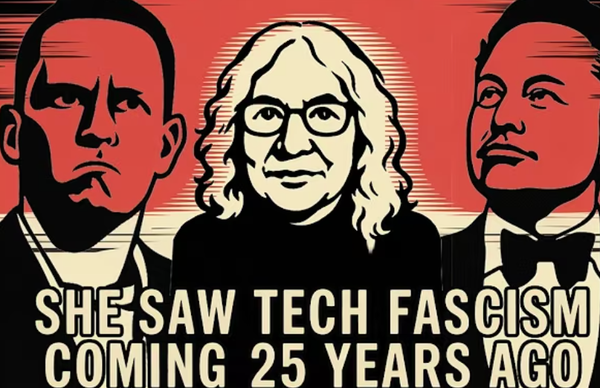
For more on how Thiel created Vance, click below to watch our five-minute explainer, “Thielbilly Elegy.”
Have You Pre-Ordered The Nerd Reich?
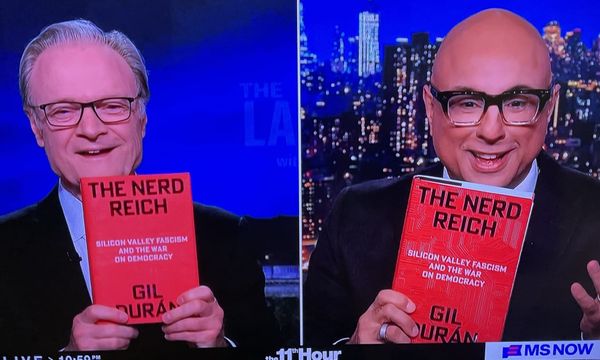
This is only a glimpse of what you’ll learn in my forthcoming book, The Nerd Reich: Silicon Valley Fascism and The War On Democracy. It details how a cult of venture capitalists—led by Thiel—is pushing a self-fulfilling prophecy of societal collapse. If you can, please pre-order it today!
Click this link to support independent bookstores and this newsletter.
Publishers Weekly: “This transfixing debut from journalist Durán investigates the antidemocratic ideologies espoused by tech billionaires linked to the second Trump administration ... It’s an ominous look at an insular elite arrayed against American democracy.”
Here’s what some amazing writers are saying about The Nerd Reich:
“A clear and compelling account of the threats posed by technofascism to democracies everywhere.” —Ruth Ben-Ghiat, historian and author of Strongmen: Mussolini to the Present
“Reader take note: Gil Durán is a deep, thoughtful, and expansive observer of events that shape the current and future of our American democracy.” —George Lakoff, author of The All New Don't Think of an Elephant!: Know Your Values and Frame the Debate
“Gil Durán is an essential voice on this technofascist moment—where it comes from and where we are going.” —Carole Cadwalladr, investigative journalist, The Nerve
“The Nerd Reich is a clarion warning about the rise of techno-fascist sociopaths who seek to profit off of our collective misery. In clear, compelling and meticulously-researched detail, Gil Durán sounds the alarm about this incestuous cabal of broligarchs. He brings the receipts and the righteous rage.” —Wajahat Ali, The Left Hook